DMAIC vs PDCA: Which One Do You Reach For? (With a Decision Table That Actually Decides)
July 7, 2026 · Framework First Academy
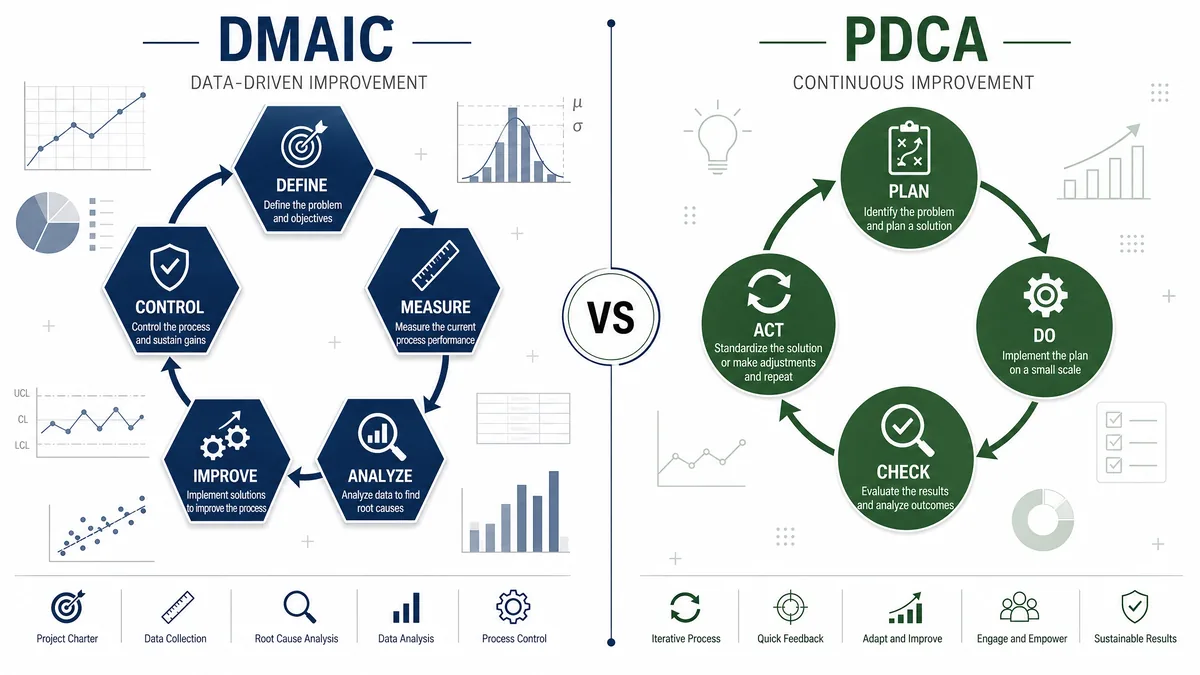
DMAIC vs PDCA: Which One Do You Reach For?
Early in my career I watched a team spend four months running a full DMAIC project — charter, SIPOC, capability study, the works — on a problem a warehouse supervisor fixed with a checklist in two weeks. Nobody was stupid. They just had one hammer, freshly certified, and everything looked like a nail.
Two frameworks dominate process improvement: DMAIC (Define, Measure, Analyze, Improve, Control) and PDCA (Plan, Do, Check, Act). Both work. Both are proven over decades. But they are not interchangeable, and picking wrong costs you either months of over-engineering or a shallow fix that comes back with friends.
Here is what each one is actually for, where each one breaks, and a decision table worth bookmarking.
What DMAIC actually is
DMAIC is the problem-solving engine inside Six Sigma — Motorola built it in the 1980s, GE weaponized it in the '90s. Five phases, and each one gates the next:
Define — bound the problem before touching data. Charter, SIPOC, customer requirements. If your problem statement contains a solution, you failed Define.
Measure — how bad is it, in numbers? Not estimates. Not "everyone agrees it's slow." Baseline data, collection plans, capability studies.
Analyze — verify the root cause statistically. Fishbones, hypothesis tests, regression. The phase ends when you can prove the cause, not when the room reaches consensus.
Improve — design, pilot, and validate a fix against that verified cause.
Control — lock it in. SPC charts, control plans, updated SOPs. Skip this and your improvement evaporates within a quarter. I've watched it happen more than once.
The defining trait: statistical rigour as a discipline. DMAIC will not let you jump to solutions. That rigidity is the feature — it's what stops smart teams from confidently solving the wrong problem.
What PDCA actually is
PDCA is older and humbler. Shewhart sketched the cycle in the 1930s; Deming carried it to Japan in 1950; it became the backbone of Total Quality Management and sits inside ISO 9001 to this day. Four stages, deliberately simple:
Plan — spot the problem, design a small test. Small is the whole point.
Do — run the pilot in one corner: one ward, one shift, one customer segment.
Check — did it work? What surprised you?
Act — standardize what worked, or loop back smarter. Every Act feeds the next Plan. That's what makes it a wheel instead of a checklist.
The defining trait: iterative speed. A PDCA cycle takes days. No belts, no statistics package, no steering committee. That accessibility is exactly why it spread from factories to hospitals to software teams.
The real difference: breakthrough vs. incremental
Forget tools and phases. The distinction that matters is the kind of improvement you're after.
DMAIC hunts root causes. Complex problem, unknown cause, high stakes, enough pain to justify months of investigation.
PDCA builds momentum. Direction broadly known, speed matters more than certainty, and you want a team that improves things every week instead of studying them every quarter.
Neither is better. Anyone who tells you otherwise is selling a certification.
DMAIC vs PDCA: side-by-side
| Dimension | DMAIC | PDCA |
|---|---|---|
| Origin | Motorola / GE, 1980s–1990s | Shewhart / Deming, 1930s–1950s |
| Phases | Define → Measure → Analyze → Improve → Control | Plan → Do → Check → Act |
| Primary goal | Breakthrough improvement, eliminate root cause | Incremental, continuous improvement |
| Statistical rigour | High — hypothesis testing, SPC, regression | Low — observation and comparison |
| Typical duration | 3–9 months per project | Days to weeks per cycle |
| Team expertise required | Green Belt or Black Belt trained practitioners | Any team member with basic training |
| Problem complexity | High — root cause unknown, multi-variable | Low to medium — direction broadly understood |
| Documentation | Extensive — charter, data collection plans, control plan | Light — cycle notes and action logs |
| Used in | Six Sigma programmes, quality improvement projects | TQM, ISO 9001, Kaizen, Agile retrospectives |
| Risk of misuse | Over-engineering small problems | Under-investigating complex problems |
When DMAIC earns its complexity
The root cause is genuinely unknown. Three managers, three theories, no way to settle it by looking. That's Analyze's home turf. Without statistical verification, teams implement solutions that address symptoms — and the problem returns.
The problem crosses departments. When the failure lives in the handoffs between functions, PDCA's small-pilot logic can't reach it. DMAIC's SIPOC and process mapping force the full system into view first.
The stakes are real. A defect rate costing millions, a compliance exposure, a major contract on the line — these justify 3–9 months and a trained practitioner. A wobbly handover checklist does not.
You can actually collect the data. If measurement is impractical, DMAIC's rigour becomes overhead. Be honest about this one — teams rarely are.
When PDCA is the right call
You roughly know the fix. New template, new layout, new handover protocol. Test it Tuesday. Don't hold a root-cause investigation for a cause you already know.
The team is new to structured improvement. PDCA builds the evidence habit without the statistical entry fee. Any team can start this week.
Speed matters more than certainty. Fast-moving operations — software, service, clinical wards — can't wait a quarter for a verdict.
The change is small and reversible. Pilot in one corner, keep what works. That is literally what the Do stage is for.
The decision table
Match your situation to the rows below and count the checkmarks.
| Your situation | Use DMAIC | Use PDCA |
|---|---|---|
| Root cause is unknown and debated | ✅ | |
| Root cause is broadly understood | ✅ | |
| Problem spans multiple departments or systems | ✅ | |
| Problem is contained within one team or process | ✅ | |
| Defect rate, variation, or cost is the primary metric | ✅ | |
| Speed of change matters more than statistical certainty | ✅ | |
| Team has Green Belt or Black Belt training | ✅ | |
| Team has no formal improvement training | ✅ | |
| A 3–9 month project duration is acceptable | ✅ | |
| Results needed within days or weeks | ✅ | |
| High financial, safety, or compliance stakes | ✅ | |
| Low-to-medium stakes, incremental improvement | ✅ | |
| Data collection is feasible and reliable | ✅ | |
| Data is limited or difficult to collect | ✅ | |
| Regulatory or audit documentation is required | ✅ | |
| Building a continuous improvement culture | ✅ |
Four or more in the DMAIC column: run DMAIC. The complexity and stakes justify the structured investment.
Four or more in the PDCA column: start a PDCA cycle now. Speed and iteration will serve you better than statistical rigour.
Split evenly? Start with PDCA to generate initial data and hypotheses. If the root cause proves elusive after a few cycles, escalate to DMAIC.
Four scenarios, decided
A hospital reducing medication errors
Errors are up 12% across multiple wards, shifts, and drug categories. Four competing theories in the room. Verdict: DMAIC. Unknown root cause, cross-functional, safety stakes. Process-map the medication pathway, find which ward/shift/drug combinations fail, verify statistically, then fix.
A warehouse team fixing handover notes
Some shifts leave detailed notes, others leave nothing. The team leader already knows the fix: a standard template. Verdict: PDCA. Pilot the template on one shift for two weeks, check adoption, refine, standardize. Done before a DMAIC charter would even be signed.
A financial services firm cutting processing time
Loan processing went from 3 days to 7. The ops manager blames staffing, the team lead blames the system, two others blame training. Verdict: DMAIC. Competing theories plus financial stakes plus measurable data — collect processing time by step and let the data settle the argument.
A software team fixing its retrospectives
Actions from retros rarely get followed through. Verdict: PDCA. Team-level, low-stakes, iterative. Try a new format for two sprints, measure action completion, adjust. PDCA is the structural logic behind the retrospective itself.
Using both — the pattern that actually works in the field
The best-run operations I've seen don't choose. They layer:
PDCA inside DMAIC's Improve phase. Verified root cause in hand, you pilot the fix small before rolling it out — that pilot is a PDCA cycle. Plan the solution, Do the pilot, Check against baseline, Act on what you learn.
PDCA as the rhythm, DMAIC as the escalation. Front-line teams run PDCA weekly. When a problem survives three cycles, that's your signal the cause runs deeper — escalate to DMAIC. Fast where speed wins, rigorous where rigour pays.
The part most training skips
Most courses teach you how to run DMAIC or PDCA — phases, tools, templates. Almost none teach when. And that decision is where improvement efforts live or die. Run DMAIC on a two-week problem and you exhaust the team. Run PDCA on a statistical root-cause problem and you get a shallow fix that recurs.
That is the whole premise of Framework First: the framework you choose shapes the outcome you get. Mastery isn't enough. Timing is the skill.
Your move: take the problem sitting on your desk right now, run it through the decision table, and count the checkmarks. If your instinct and the table disagree — trust the table, and see what happens.
Frequently asked questions
Is DMAIC better than PDCA? No. Different animals. DMAIC for complex, data-rich problems with unknown causes; PDCA for speed and iteration on understood ones. Use the table.
Can PDCA live inside a DMAIC project? It should. Improve-phase pilots are PDCA cycles in everything but name.
How long does each take? DMAIC: 3–9 months. PDCA: days to weeks. If your PDCA cycle takes months, it's not PDCA anymore.
Which one does ISO 9001 use? PDCA — the standard's structure maps directly onto Plan, Do, Check, Act.
Do I need a Six Sigma belt to use DMAIC? Legally, no. Practically, the Measure and Analyze phases reward real statistical training — without it, PDCA is the smarter starting point. Earn the belt when the problems justify it.
Cite this page
APA
Framework First Academy. (2026, July 7). DMAIC vs PDCA: Which One Do You Reach For? (With a Decision Table That Actually Decides). Framework First Academy. https://www.frameworkfirst.site/blog/dmaic-vs-pdca-which-to-use
BibTeX
@misc{ffa-2026,
  author = {Framework First Academy},
  title = {DMAIC vs PDCA: Which One Do You Reach For? (With a Decision Table That Actually Decides)},
  year = {2026},
  howpublished = {\url{https://www.frameworkfirst.site/blog/dmaic-vs-pdca-which-to-use}},
  note = {Accessed: 2026-09-09}
}Learn the framework behind the article
30 courses. Four stages. Every one starts with the situation, not the syllabus.
Explore coursesKeep reading
Python vs Excel for Data Analysis: A Framework Decision Guide
Python vs Excel for data analysis — a structured decision framework to help analysts choose the right tool based on dataset size, complexity, automation needs, and career trajectory.
Lean Six Sigma vs Six Sigma: Differences & When to Use Each
Understand the key differences between Lean Six Sigma and Six Sigma, when to use each, and how to choose the right roadmap for your process improvement goals.
Scrum vs Kanban: Agile Framework Comparison
Scrum vs Kanban — a framework-focused comparison of two leading Agile methodologies, including a decision guide to help teams choose the right approach for their context.