Scrum vs Kanban: Agile Framework Comparison
May 21, 2026 · Framework First Academy
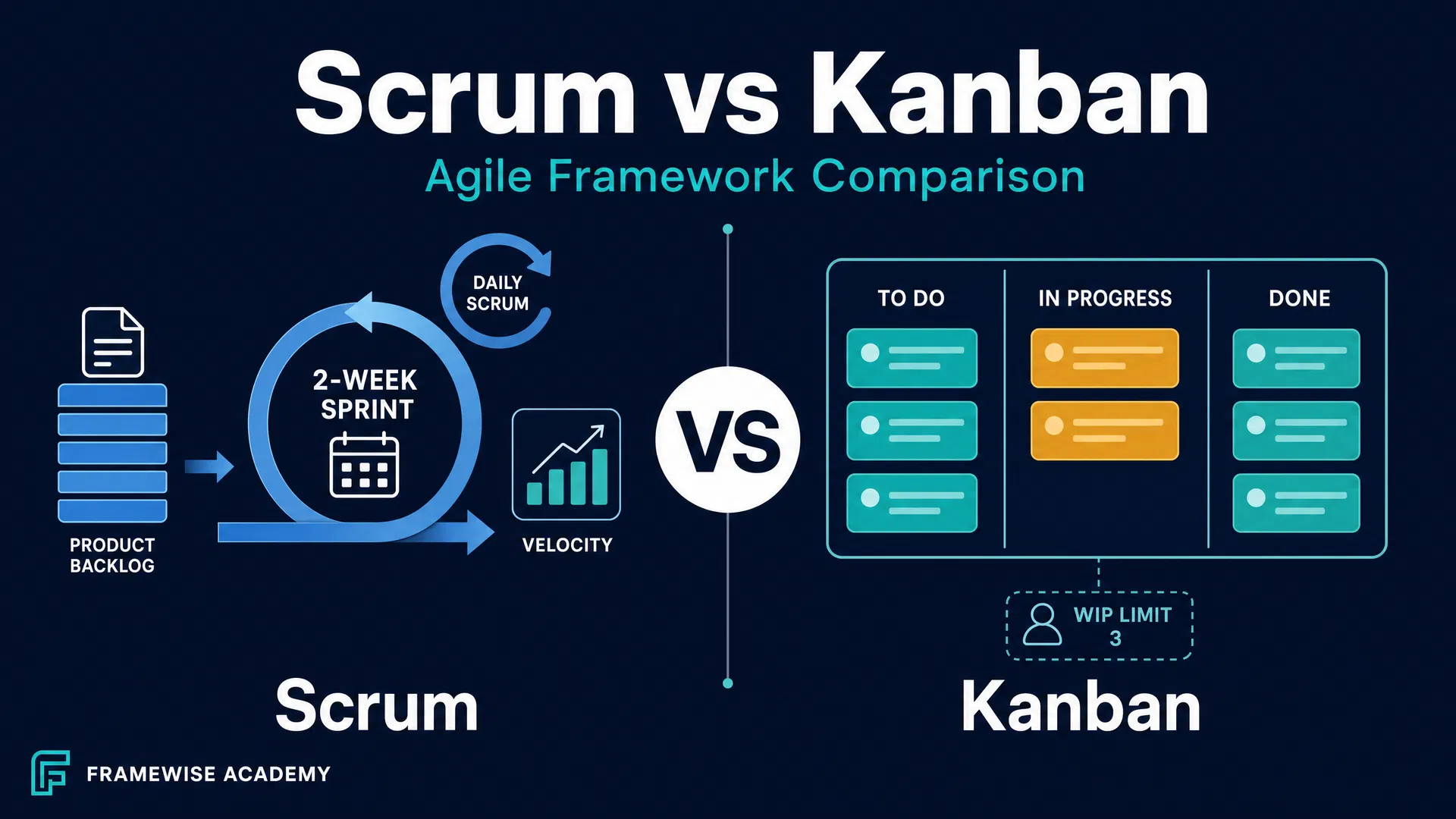
The modern project management landscape constantly evolves, driven by the need for adaptability and efficiency. At its core lies Agile, a philosophy championing iterative development, collaboration, and rapid response to change. Within Agile, Scrum vs Kanban emerge as leading frameworks. Both offer distinct approaches to organizing work, managing complexity, and delivering value, yet they are often misunderstood. For practitioners, understanding their fundamental principles and applications is crucial. This article dissects these powerful frameworks, highlighting differences and providing a clear decision framework to help determine which approach, or combination, best suits your project and team. We'll explore how structured thinking illuminates each framework's strengths, moving beyond superficial comparisons to reveal their underlying mental models.
Introduction to Agile: Scrum and Kanban
Agile is not a methodology, but a set of values and principles from the Agile Manifesto, designed for rapid value delivery and effective change response. It marks a shift from traditional, predictive Waterfall approaches, advocating instead for adaptive planning, evolutionary development, early delivery, and continuous improvement. This philosophical foundation is vital for navigating the complexities and uncertainties of modern product development.
Scrum and Kanban are two widely adopted frameworks within this Agile philosophy. While both are rooted in Agile principles, they offer distinct operational and mental models. Scrum, originating in software development, provides a prescriptive framework for iterative and incremental work delivery. Kanban, stemming from lean manufacturing, focuses on visualizing work, limiting work-in-progress (WIP), and maximizing efficiency through continuous flow. Understanding these foundational differences is the first step in applying framework thinking to project management, enabling conscious choices rather than defaulting to a single approach.
Scrum: Iteration, Roles, and Ceremonies
Scrum is an iterative and incremental Agile framework for product development. Its strength lies in delivering value through short, fixed-length sprints, typically 1-4 weeks. Each sprint is a mini-project, aiming for a potentially shippable increment. This iterative cycle allows frequent inspection and adaptation, enabling teams to respond to feedback and changing requirements. Scrum's predictable cadence helps teams maintain a sustainable pace and provides stakeholders regular progress updates.
Scrum defines roles that foster collaboration and accountability. The Product Owner maximizes product value by managing the Product Backlog. The Scrum Master acts as a servant-leader, ensuring Scrum is understood and coaching the team in self-organization. The Development Team delivers a potentially releasable Increment. These roles create a self-organizing, cross-functional team. Scrum also prescribes ceremonies (events) to structure the sprint: Sprint Planning, Daily Scrum, Sprint Review, and Sprint Retrospective. These events provide regular opportunities for planning, tracking, inspection, and adaptation, reinforcing the iterative nature. The underlying framework thinking is that clear structure and rhythm enable predictable delivery while remaining agile.
Kanban: Flow, WIP Limits, and Flexibility
In contrast to Scrum's time-boxed approach, Kanban emphasizes continuous flow and flexibility, drawing from lean manufacturing. Its core idea is to visualize work, limit WIP, and maximize efficiency by reducing bottlenecks. Kanban is less prescriptive than Scrum, focusing on evolutionary change and allowing teams to gradually improve existing processes. A visual Kanban board, with columns representing work stages, provides transparency and highlights areas for improvement. This focus on flow and continuous delivery suits environments with frequent priority shifts or a steady stream of work.
Kanban's key practices include visualizing workflow, limiting WIP, managing flow, making process policies explicit, implementing feedback loops, and improving collaboratively. Visualizing the workflow typically uses a Kanban board, moving tasks from "To Do" to "Done." Limiting WIP prevents overburdening and maintains smooth flow. Explicit WIP limits force teams to complete current tasks before starting new ones, reducing context switching and improving throughput. Managing flow involves monitoring work item movement, identifying blockages. Unlike Scrum, Kanban doesn't prescribe specific roles or fixed iterations, offering greater flexibility. The framework thinking here optimizes the system as a whole, focusing on continuous value delivery and adapting to change through small, incremental improvements.
Key Differences: Scrum vs Kanban
Both Scrum and Kanban are powerful Agile frameworks, but their operational mechanics and philosophies differ significantly. Understanding these distinctions is paramount for applying framework thinking. Scrum is highly prescriptive, offering defined roles, events, and artifacts, beneficial for new Agile teams or those needing clear, repeatable processes. Kanban is more descriptive, focusing on principles applicable to existing workflows, making it adaptable and less disruptive.
Their approach to time and iteration is a key difference. Scrum uses fixed-length sprints, creating a rhythmic cadence for delivery and review. This time-boxed approach provides predictability for stakeholders and encourages commitment to a specific scope. Kanban emphasizes continuous flow; work items move through the system as capacity allows. There are no fixed iterations, and new work can be pulled at any time, offering flexibility for rapidly changing priorities. This divergence in time management is crucial when considering project variability and urgency.
To further clarify these distinctions, the following table provides a comparative overview of Scrum and Kanban across several critical dimensions:
| Feature | Scrum | Kanban |
|---|---|---|
| Cadence | Fixed-length Sprints (e.g., 1-4 weeks) | Continuous flow, no fixed iterations |
| Roles | Prescribed (Product Owner, Scrum Master, Development Team) | No prescribed roles, existing roles often maintained |
| Change | Changes discouraged within a Sprint, embraced between Sprints | Changes can be introduced at any time, as long as WIP limits are respected |
| Metrics | Velocity, Sprint Burndown | Lead Time, Cycle Time, Throughput, WIP |
| Focus | Delivering working software incrementally | Optimizing flow and reducing lead time |
| WIP Limits | Implicit (Sprint Backlog) | Explicitly defined and enforced |
| Origin | Software development | Lean manufacturing |
When to Choose Scrum
Choosing between Scrum and Kanban requires deliberate framework thinking, aligning project and team characteristics with each approach's strengths. Scrum suits projects benefiting from a structured, iterative development cycle with clear, predictable delivery cadences. If your project needs fixed-length iterations and a defined increment of work within a specific timeframe, Scrum's sprint-based approach provides rhythm and discipline. This predictability is crucial for stakeholders needing regular updates and clear understanding of deliverables.
Scrum thrives where team roles are clearly defined and collaboration is fostered through ceremonies. If your team benefits from dedicated roles like a Product Owner, Scrum Master, and a self-organizing Development Team, Scrum's structure provides a robust operational model. This framework encourages team cohesion and shared responsibility, effective for complex product development requiring cross-functional collaboration. Regular inspection and adaptation points in Scrum ensure continuous learning and improvement, making it ideal for projects with evolving requirements needing a structured approach. When considering Scrum vs Kanban, if your project leans towards predictable delivery and a well-defined team structure, Scrum is a compelling framework.
When to Choose Kanban
Conversely, Kanban excels in scenarios demanding continuous flow, high flexibility, and minimal overhead. If your project or operational environment features frequently changing priorities, unpredictable work arrival, or a need for rapid response, Kanban’s pull-based system and lack of fixed iterations offer significant advantages. It's effective for maintenance teams, support operations, or workflows managing a steady stream of diverse tasks. The ability to introduce new work items as capacity becomes available ensures critical tasks are addressed, optimizing value flow without sprint constraints.
Kanban’s emphasis on visualizing work and explicitly limiting Work-in-Progress (WIP) improves efficiency and reduces bottlenecks. If your team struggles with overburdening, context switching, or unclear workflow stages, Kanban provides transparency and a clear path to improvement. It encourages completing existing tasks before starting new ones, enhancing throughput and reducing lead times. Kanban is less disruptive to implement than Scrum, allowing incremental process evolution. It's an excellent choice for organizations adopting Agile principles without radical overhaul. For continuous delivery, adaptability to shifting demands, and optimizing the value stream, Kanban offers a robust and flexible framework.
Hybrid Approaches: Scrumban
Recognizing that neither Scrum nor Kanban is a one-size-fits-all solution, many organizations adopt hybrid approaches like Scrumban. This methodology combines Scrum's structured cadence and roles with Kanban's continuous flow and WIP limits. The framework thinking behind Scrumban creates an adaptable yet organized system, beneficial for teams with a mix of predictable development and unpredictable operational tasks. It allows teams to maintain Scrum's iterative planning and review cycles while gaining flexibility to manage emergent work and optimize flow through Kanban principles.
Scrumban typically uses Scrum’s sprints for planning and retrospectives, providing a regular rhythm for inspection and adaptation. Within these sprints, work is managed using Kanban principles, such as visualizing workflow and enforcing WIP limits. Instead of committing to a fixed sprint scope, teams pull work from the backlog as capacity becomes available. This hybrid model offers a pragmatic solution for teams needing structure and predictability, but also agility to respond quickly to changing priorities without disrupting an entire sprint. It demonstrates the flexibility of Agile principles to create bespoke solutions fitting unique operational contexts.
Making the Right Choice: A Decision Framework
Choosing between Scrum and Kanban, or a hybrid like Scrumban, isn't about finding a universally "better" framework, but applying a decision framework to align the methodology with your specific context. This involves assessing project characteristics, team dynamics, and the organizational environment. A thoughtful practitioner understands the "right" choice is dynamic. The core of this framework thinking lies in asking targeted questions about predictability, flexibility, team structure, and the nature of the work. This approach moves beyond dogmatic adherence, embracing an adaptive mindset that prioritizes effective delivery.
Consider this decision framework:
Address common misconceptions: Scrum and Kanban are not interchangeable; Kanban has structure, just less prescriptive; Scrum isn't only for software development; Agile means adaptive planning, not no planning. Dispelling these myths enables informed decisions, grounded in a clear understanding of each framework's utility.
Conclusion
The choice between Scrum and Kanban, or any project management framework, is strategic, impacting team effectiveness and project success. It's a deliberate exercise in framework thinking – understanding principles, strengths, and limitations, then aligning them with your context. Both offer powerful pathways to agility, fostering collaboration, continuous improvement, and value delivery. Scrum provides structured, iterative cadence for predictable development; Kanban champions continuous flow and flexibility for dynamic environments. Hybrid models like Scrumban underscore adaptability and pragmatic application over rigid adherence.
Ultimately, the most effective approach is consciously chosen, continuously refined, and deeply understood by the team. By applying a robust decision framework, practitioners move beyond superficial comparisons, selecting the methodology that truly empowers their teams to thrive and deliver exceptional results.
Ready to master Agile methodologies and elevate your project management skills? Explore the Project Management Track at Framework First Academy.
Continue Learning at Framework First Academy
Cite this page
APA
Framework First Academy. (2026, May 21). Scrum vs Kanban: Agile Framework Comparison. Framework First Academy. https://www.frameworkfirst.site/blog/scrum-vs-kanban-agile-framework-comparison
BibTeX
@misc{ffa-2026,
  author = {Framework First Academy},
  title = {Scrum vs Kanban: Agile Framework Comparison},
  year = {2026},
  howpublished = {\url{https://www.frameworkfirst.site/blog/scrum-vs-kanban-agile-framework-comparison}},
  note = {Accessed: 2026-09-09}
}Learn the framework behind the article
30 courses. Four stages. Every one starts with the situation, not the syllabus.
Explore coursesKeep reading
DMAIC vs PDCA: Which One Do You Reach For? (With a Decision Table That Actually Decides)
DMAIC or PDCA? This in-depth guide breaks down the key differences, a side-by-side comparison, and a practical decision table to help you choose the right process improvement framework for your situation — with four real-world scenarios.
Python vs Excel for Data Analysis: A Framework Decision Guide
Python vs Excel for data analysis — a structured decision framework to help analysts choose the right tool based on dataset size, complexity, automation needs, and career trajectory.
Lean Six Sigma vs Six Sigma: Differences & When to Use Each
Understand the key differences between Lean Six Sigma and Six Sigma, when to use each, and how to choose the right roadmap for your process improvement goals.