Lean Six Sigma vs Six Sigma: Differences & When to Use Each
May 21, 2026 · Framework First Academy
In the realm of process improvement, two methodologies frequently emerge as cornerstones for operational excellence: Six Sigma and Lean. Understanding the nuanced differences between Lean Six Sigma vs Six Sigma is crucial for any organization aiming to optimize its processes effectively. This article delves into the core tenets of each, explores their synergistic hybrid, and provides a framework for deciding which approach best suits specific challenges.
Understanding Six Sigma
Six Sigma is a data-driven methodology focused on eliminating defects and reducing variation. Its primary goal is to achieve near-perfect quality, aiming for no more than 3.4 defects per million opportunities (DPMO). This rigorous approach employs statistical analysis to identify and remove defect causes, minimizing errors and improving consistency. The underlying framework emphasizes measurement and control, ensuring sustained improvements. It's not just tools, but a disciplined strategy for achieving significant, measurable financial returns through quality enhancement. Adopting Six Sigma often stems from recognizing that inconsistent outputs erode customer trust and operational efficiency, necessitating a structured approach to pinpoint and rectify systemic flaws.
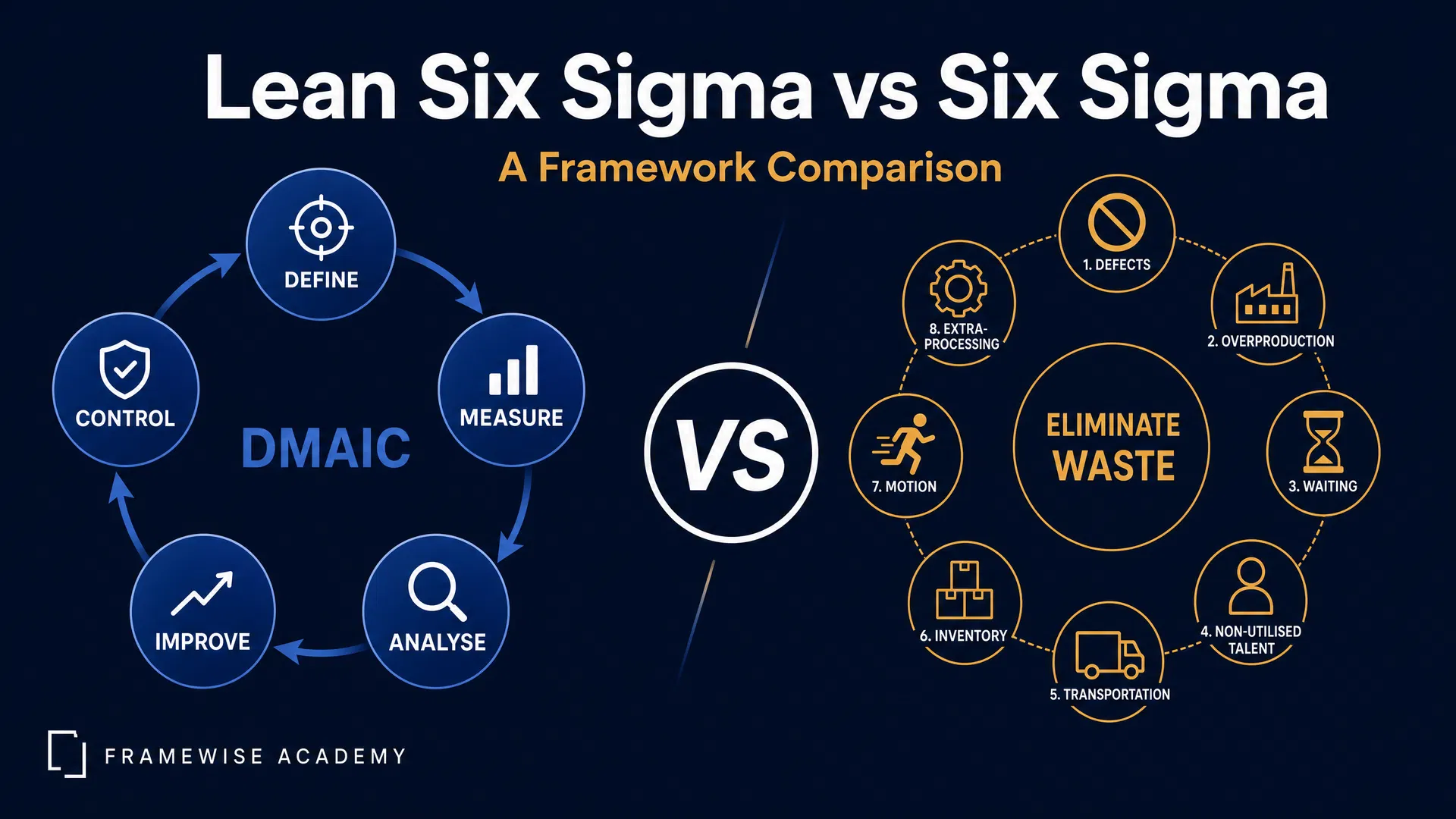
The philosophy behind Six Sigma is rooted in the belief that process variation is the enemy of quality. By systematically reducing this variation, organizations produce products and services that consistently meet customer expectations. The methodology typically follows the DMAIC (Define, Measure, Analyze, Improve, Control) roadmap for improving existing processes. This structured thinking ensures decisions are based on empirical evidence, leading to robust and lasting improvements. It's a mental model prioritizing precision and predictability, transforming chaotic processes into controlled, high-performing systems.
The Lean Methodology
In contrast to Six Sigma's focus on defects, Lean methodology centers on maximizing customer value by eliminating waste. Originating from the Toyota Production System, Lean identifies and systematically removes non-value-adding activities. The core principle is to do more with less, optimizing flow and responsiveness. Lean thinking encourages continuous improvement, empowering every team member to identify and address inefficiencies. It's a framework for operational agility, designed to streamline processes and deliver value faster and more efficiently. The adoption of Lean reflects a strategic choice to enhance responsiveness and resource utilization, often driven by competitive pressures to deliver value with greater speed and less overhead.
Lean identifies eight types of waste, often remembered by the acronym DOWNTIME: Defects, Overproduction, Waiting, Non-Utilized Talent, Transportation, Inventory, Motion, and Extra Processing. By systematically targeting these areas, organizations reduce lead times, lower costs, and improve overall productivity. The decision framework inherent in Lean asks "what adds value to the customer?" and "what can be eliminated without compromising quality or service?" This relentless pursuit of efficiency fosters continuous improvement and adaptability, crucial for dynamic market conditions. It's a mental model prioritizing value flow, seeking to remove any impediment to its smooth progression.
Lean Six Sigma: The Hybrid Approach
Recognizing the complementary strengths of both, Lean Six Sigma emerged as a powerful hybrid. It combines Six Sigma's emphasis on reducing defects and variation with Lean's focus on eliminating waste and improving flow. The result is a comprehensive framework for end-to-end process improvement, addressing both efficiency and quality simultaneously. Lean Six Sigma practitioners leverage tools and principles from both disciplines to achieve more significant and sustainable results than either could alone. This integrated approach acknowledges that waste often contributes to defects, and defects often lead to waste, making a combined strategy highly effective. Choosing Lean Six Sigma signifies a commitment to holistic process optimization, understanding that quality and efficiency are two sides of the same operational coin.
Lean Six Sigma provides a holistic decision framework for process optimization. It allows organizations to tackle complex problems involving both quality issues and inefficiencies. By applying Lean Six Sigma, practitioners identify root causes of both problems and implement integrated solutions. This synergistic approach ensures improvements are effective and efficient, leading to enhanced customer satisfaction and operational performance. It's a mental model seeking comprehensive solutions, recognizing the interconnectedness of operational challenges.
DMAIC vs. DMADV: Choosing the Right Roadmap
Within Six Sigma and Lean Six Sigma, two primary roadmaps guide improvement efforts: DMAIC and DMADV. The choice is critical, reflecting the problem's nature. DMAIC (Define, Measure, Analyze, Improve, Control) improves existing processes not meeting targets. DMADV (Define, Measure, Analyze, Design, Verify) is proactive, designing new processes or redesigning fundamentally flawed ones that cannot be improved through DMAIC. It's about creating a process from scratch or significantly overhauling one to meet specific customer requirements and performance goals.
The decision framework for choosing between DMAIC and DMADV is straightforward: if the primary objective is to enhance an existing process, DMAIC is appropriate. If the goal is to create a new process or completely redesign a broken one, DMADV is preferred. This distinction is vital for effective project execution. Understanding this framework ensures the right tools are applied to the right problems, maximizing successful outcomes. This choice reveals a practitioner's understanding of whether the current process needs refinement or a complete reimagining.
Certification Paths and Belt Levels
Both Six Sigma and Lean Six Sigma utilize a structured belt-level certification system, signifying different levels of expertise and responsibility. These certifications provide a clear career path and ensure a standardized understanding of principles and tools. The belt system is a framework for professional development, allowing individuals to progressively deepen their knowledge and skills. It also helps organizations identify individuals with appropriate expertise to lead or contribute to improvement projects. The decision to pursue a specific belt level is often a strategic career move, aligning personal development with organizational needs for skilled problem-solvers.
This hierarchical structure provides a clear framework for skill development and project leadership, ensuring improvement initiatives are guided by appropriately qualified personnel. The decision to pursue a particular belt level often depends on an individual's career aspirations and organizational need for specific levels of expertise, reflecting a commitment to structured problem-solving and leadership.
Industry Adoption and Real-World Applications
Six Sigma and Lean Six Sigma have seen widespread adoption across diverse industries, demonstrating versatility and effectiveness in driving operational excellence. While Six Sigma originated in manufacturing, its principles of defect reduction and variation control have proven invaluable in sectors such as healthcare, finance, and services. For example, a hospital might use Six Sigma to reduce medication errors or improve patient discharge times. A financial institution could apply it to minimize errors in transaction processing. The decision to apply Six Sigma in these varied contexts highlights a universal need for precision and reliability, regardless of the output.
Lean, with its focus on waste elimination and efficiency, has also found broad application beyond its manufacturing roots. In software development, Agile and Scrum methodologies draw heavily from Lean principles to streamline workflows and deliver value incrementally. In service industries, Lean helps reduce customer waiting times and optimize service delivery processes. Lean Six Sigma, as the combined approach, is particularly powerful in complex environments where both quality and efficiency are critical. A logistics company, for instance, might use Lean Six Sigma to reduce delivery errors while simultaneously optimizing route planning and fuel consumption. The decision to adopt these methodologies is often driven by a strategic imperative to enhance competitiveness and customer satisfaction, reflecting a framework for continuous adaptation and improvement.
Deciding Between Lean Six Sigma and Six Sigma
The choice between implementing Lean Six Sigma and Six Sigma depends on the specific challenges an organization faces and its strategic objectives. It's not a matter of one being inherently superior, but rather selecting the framework that best addresses the core problem. A clear decision framework can guide this selection process:
| Feature | Six Sigma | Lean | Lean Six Sigma |
|---|---|---|---|
| Primary Focus | Defect reduction, variation control | Waste elimination, flow optimization | Defect reduction, waste elimination, flow |
| Key Metric | Defects Per Million Opportunities (DPMO) | Lead time, cycle time, inventory turnover | DPMO, lead time, efficiency metrics |
| Problem Type | High defect rates, quality inconsistency | Inefficiency, waste, slow process flow | Comprehensive end-to-end process issues |
| Origin | Motorola | Toyota Production System | Combination of Six Sigma and Lean |
| Approach | Data-driven, statistical analysis | Value stream mapping, continuous flow | Integrated, holistic |
| Roadmap | DMAIC (existing), DMADV (new) | Value Stream Mapping, Kaizen events | DMAIC, DMADV, Lean tools |
Decision Framework:
This framework emphasizes that the "right" choice is context-dependent, requiring a clear understanding of the problem statement and desired outcomes. It's about applying the most suitable mental model to the specific operational challenge, and understanding what that choice reveals about how one thinks about problem-solving.
Common Misconceptions
Several misconceptions often cloud the understanding of Lean, Six Sigma, and Lean Six Sigma. Addressing these can help practitioners adopt a more accurate and effective framework for process improvement.
One common misconception is that Lean Six Sigma is just Six Sigma with a new name. This overlooks the distinct contributions of Lean, particularly its focus on waste elimination and flow. While they share common ground in continuous improvement, Lean Six Sigma is a true integration, not merely a rebranding. Another fallacy is that Lean and Six Sigma are competing methodologies. In reality, they are highly complementary. Six Sigma provides the rigor for quality, while Lean provides the agility for efficiency. Their combined power in Lean Six Sigma demonstrates their synergistic relationship, revealing a framework for understanding how seemingly disparate approaches can converge for greater impact.
Furthermore, the idea that Six Sigma is only for manufacturing is outdated. Its application has expanded significantly across all sectors where processes exist and variation needs to be controlled. Finally, the notion that Lean Six Sigma is outdated is far from the truth. In an increasingly competitive and dynamic business landscape, the principles of quality, efficiency, and continuous improvement are more relevant than ever. Organizations continue to leverage these frameworks to adapt, innovate, and deliver superior value to their customers.
These misconceptions often stem from a lack of framework thinking, where methodologies are viewed in isolation rather than as adaptable tools within a broader problem-solving toolkit. A nuanced understanding reveals their enduring value and applicability, and how a mature practitioner approaches complex operational challenges.
Conclusion
Navigating the landscape of process improvement requires a clear understanding of the frameworks available. The choice between Lean Six Sigma vs Six Sigma is not about declaring a winner, but about applying the right mental model to the right problem. Six Sigma offers a powerful framework for tackling defects and variation, while Lean provides a robust approach to eliminating waste and enhancing flow. Their integration into Lean Six Sigma creates a comprehensive strategy for holistic operational excellence.
Ultimately, the decision framework presented here empowers practitioners to make informed choices, ensuring that improvement efforts are targeted, effective, and aligned with strategic goals. By embracing these methodologies, organizations can cultivate a culture of continuous improvement, driving sustained quality and efficiency. This commitment to framework thinking is what truly differentiates effective problem-solvers.
Ready to master process optimization? Explore the Lean Six Sigma Track at Framework First Academy.
Continue Learning at Framework First Academy
Cite this page
APA
Framework First Academy. (2026, May 21). Lean Six Sigma vs Six Sigma: Differences & When to Use Each. Framework First Academy. https://www.frameworkfirst.site/blog/lean-six-sigma-vs-six-sigma-comparison
BibTeX
@misc{ffa-2026,
  author = {Framework First Academy},
  title = {Lean Six Sigma vs Six Sigma: Differences & When to Use Each},
  year = {2026},
  howpublished = {\url{https://www.frameworkfirst.site/blog/lean-six-sigma-vs-six-sigma-comparison}},
  note = {Accessed: 2026-09-09}
}Learn the framework behind the article
30 courses. Four stages. Every one starts with the situation, not the syllabus.
Explore coursesKeep reading
DMAIC vs PDCA: Which One Do You Reach For? (With a Decision Table That Actually Decides)
DMAIC or PDCA? This in-depth guide breaks down the key differences, a side-by-side comparison, and a practical decision table to help you choose the right process improvement framework for your situation — with four real-world scenarios.
Scrum vs Kanban: Agile Framework Comparison
Scrum vs Kanban — a framework-focused comparison of two leading Agile methodologies, including a decision guide to help teams choose the right approach for their context.
Python vs Excel for Data Analysis: A Framework Decision Guide
Python vs Excel for data analysis — a structured decision framework to help analysts choose the right tool based on dataset size, complexity, automation needs, and career trajectory.