Theranos: The $9 Billion Case Study in What Happens When Critical Thinking Fails
May 1, 2026 · Framework First Academy
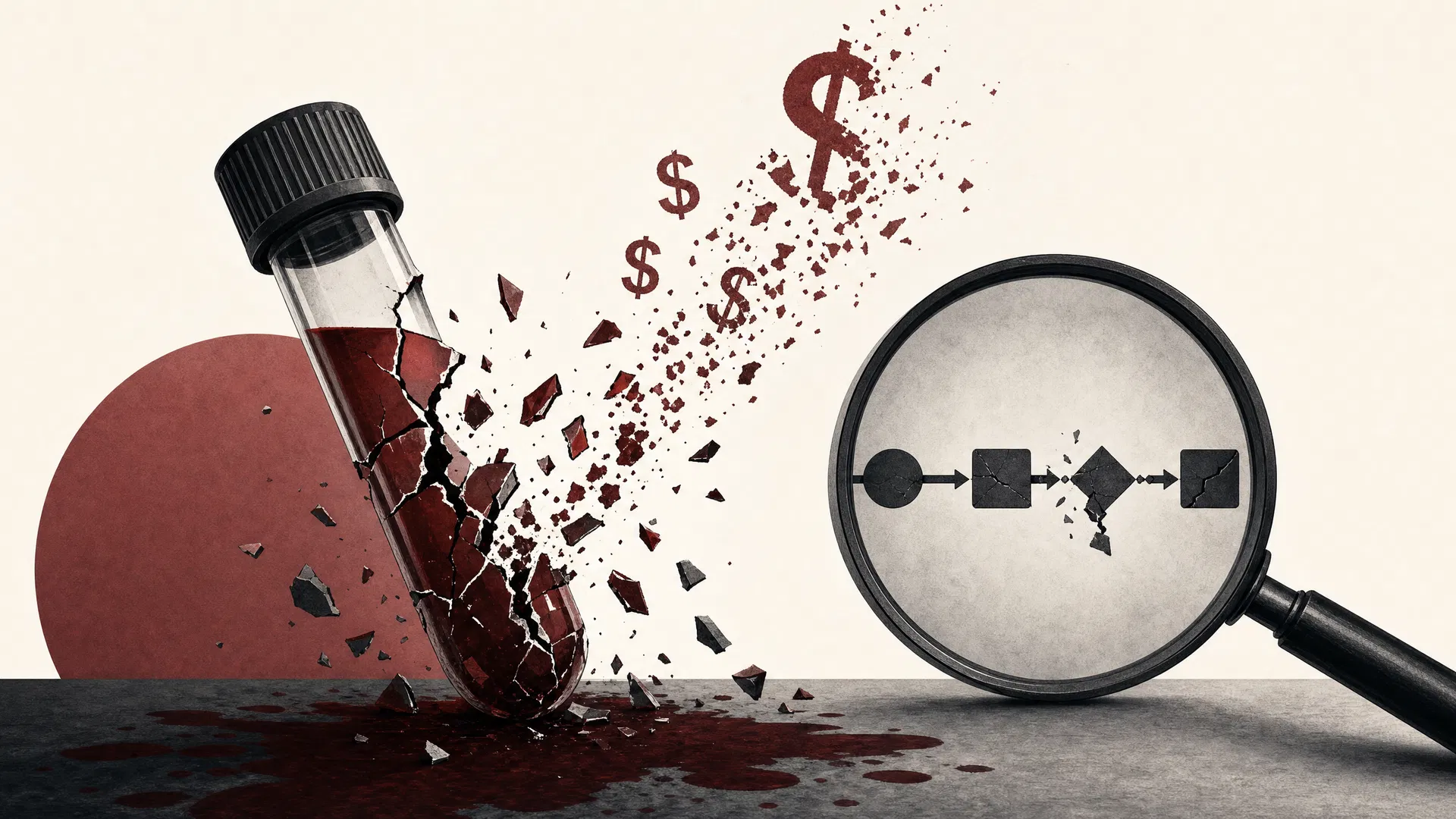
In 2015, Elizabeth Holmes was the world's youngest self-made female billionaire. Theranos, the blood-testing company she had founded at 19, was valued at $9 billion. Its technology, Holmes claimed, could run hundreds of medical tests from a single drop of blood using a proprietary device called the Edison. The company had partnerships with Walgreens and Safeway. Its board included George Shultz, Henry Kissinger, and James Mattis.
By 2018, Theranos had dissolved. Holmes had been indicted on federal fraud charges. Patients who had received Theranos test results — results that were, in many cases, wildly inaccurate — had made medical decisions based on false data. In January 2022, Holmes was convicted on four counts of fraud and conspiracy. She was sentenced to more than eleven years in federal prison.
The Theranos story is one of the most studied business failures of the modern era. It is also one of the most instructive — not because it is a story about exceptional fraud, but because it is a story about how ordinary failures of critical thinking, at every level, allowed an extraordinary deception to persist for years.
The Evidence That Was Not Examined
The most striking feature of the Theranos story is not that Holmes deceived investors and partners. It is that the deception was, in retrospect, not particularly difficult to detect — if anyone had applied basic critical thinking to the claims being made.
Theranos claimed that its Edison device could run over 200 tests from a single finger-prick of blood. This claim was, from a biochemical standpoint, implausible. The volume of blood in a finger-prick is approximately 50 microlitres. Many standard blood tests require significantly more than this. Experienced laboratory scientists and haematologists who reviewed the claims publicly expressed scepticism — but their scepticism was dismissed or ignored.
The investors who poured hundreds of millions of dollars into Theranos — including Rupert Murdoch, the DeVos family, and the Walton family — did not conduct the kind of due diligence that the claims warranted. They did not bring in independent laboratory scientists to verify the technology. They did not ask for peer-reviewed validation. They accepted demonstrations that were, as later investigation revealed, staged using conventional laboratory equipment rather than the Edison device.
This is the first critical thinking failure: the failure to match the level of scrutiny to the magnitude of the claim. Extraordinary claims require extraordinary evidence. The claim that a single drop of blood could replace a full blood draw for hundreds of tests was extraordinary. The evidence provided was a charismatic founder, a compelling narrative, and demonstrations that were never independently verified.
The Authority Bias That Silenced Doubt
The second critical thinking failure was authority bias — the tendency to accept claims from people who appear credible, regardless of whether their credibility is relevant to the specific claim being made.
Theranos's board was stacked with distinguished figures from government, military, and business. None of them had expertise in laboratory medicine, biochemistry, or medical device development. Their presence on the board signalled credibility — but it was credibility in domains entirely unrelated to the core technical claims of the company.
When employees with relevant expertise raised concerns — and many did, including the company's own laboratory director — they were dismissed, threatened with legal action, or forced out. The organisation had constructed a culture in which questioning the technology was treated as disloyalty rather than due diligence.
This pattern — where authority figures provide social proof for claims they are not qualified to evaluate, and where internal dissent is suppressed — is not unique to Theranos. It appears in every major corporate fraud and in many non-fraudulent organisational failures. The antidote is a specific critical thinking practice: evaluating the relevance of a source's credibility to the specific claim being made, not just their general prestige.
The Narrative Trap
The third failure was what psychologists call narrative bias — the tendency to accept a story that is coherent and emotionally compelling as evidence that the story is true.
Holmes was an extraordinarily effective storyteller. The narrative she constructed — a young woman who dropped out of Stanford to democratise healthcare, who wanted to make blood testing as accessible as a smartphone app, who was driven by a personal fear of needles — was compelling, coherent, and emotionally resonant. It fit a recognisable template: the visionary founder disrupting an entrenched industry.
The narrative was so compelling that it substituted for evidence. Journalists wrote profiles without seeking independent technical validation. Investors wrote cheques without conducting scientific due diligence. Partners signed agreements without verifying that the technology worked.
The lesson is not that compelling narratives are inherently suspicious. It is that the emotional resonance of a narrative is not evidence of its truth. Critical thinking requires the discipline to separate the quality of the story from the quality of the evidence — and to apply the same scrutiny to a story you want to believe as to one you are inclined to doubt.
What the Numbers Actually Showed
When John Carreyrou of the Wall Street Journal began investigating Theranos in 2015, the evidence he found was not subtle. Theranos was running the vast majority of its tests on conventional third-party laboratory equipment — Siemens and other standard analysers — not on the Edison device. The Edison device was being used for only a small fraction of tests, and its results were frequently inaccurate.
A 2016 inspection by the Centers for Medicare and Medicaid Services found that Theranos's laboratory practices posed immediate jeopardy to patient health and safety. The company's quality control records showed systematic problems that had been present for years.
The data was there. The problems were visible in the numbers. But the data was not being examined by the people with the authority to act on it — because the narrative had displaced the evidence.
The Broader Lesson
Theranos was an extreme case. But the cognitive failures it illustrates — insufficient scrutiny of extraordinary claims, authority bias, narrative substituting for evidence, suppression of internal dissent — are present in organisations of every size and type.
The professionals who are most resistant to these failures are not the most sceptical or the most cynical. They are the ones who have developed specific, practised habits of critical thinking: matching scrutiny to the magnitude of claims, evaluating source credibility against the specific domain of the claim, separating narrative quality from evidentiary quality, and creating environments where dissent is treated as valuable rather than threatening.
Those habits are not natural. They are learned. And the cost of not learning them — as Theranos demonstrated — can be measured in billions of dollars, in destroyed careers, and in patients who made life-altering medical decisions based on results that were never real.
Cite this page
APA
Framework First Academy. (2026, May 1). Theranos: The $9 Billion Case Study in What Happens When Critical Thinking Fails. Framework First Academy. https://www.frameworkfirst.site/blog/theranos-critical-thinking-failure-case-study
BibTeX
@misc{ffa-2026,
  author = {Framework First Academy},
  title = {Theranos: The $9 Billion Case Study in What Happens When Critical Thinking Fails},
  year = {2026},
  howpublished = {\url{https://www.frameworkfirst.site/blog/theranos-critical-thinking-failure-case-study}},
  note = {Accessed: 2026-09-09}
}Learn the framework behind the article
30 courses. Four stages. Every one starts with the situation, not the syllabus.
Explore coursesKeep reading
DMAIC vs PDCA: Which One Do You Reach For? (With a Decision Table That Actually Decides)
DMAIC or PDCA? This in-depth guide breaks down the key differences, a side-by-side comparison, and a practical decision table to help you choose the right process improvement framework for your situation — with four real-world scenarios.
Python vs Excel for Data Analysis: A Framework Decision Guide
Python vs Excel for data analysis — a structured decision framework to help analysts choose the right tool based on dataset size, complexity, automation needs, and career trajectory.
Lean Six Sigma vs Six Sigma: Differences & When to Use Each
Understand the key differences between Lean Six Sigma and Six Sigma, when to use each, and how to choose the right roadmap for your process improvement goals.