Lean Thinking Is Not About Cutting Costs. It Is About Seeing Waste You Did Not Know Existed.
May 7, 2026 · Framework First Academy
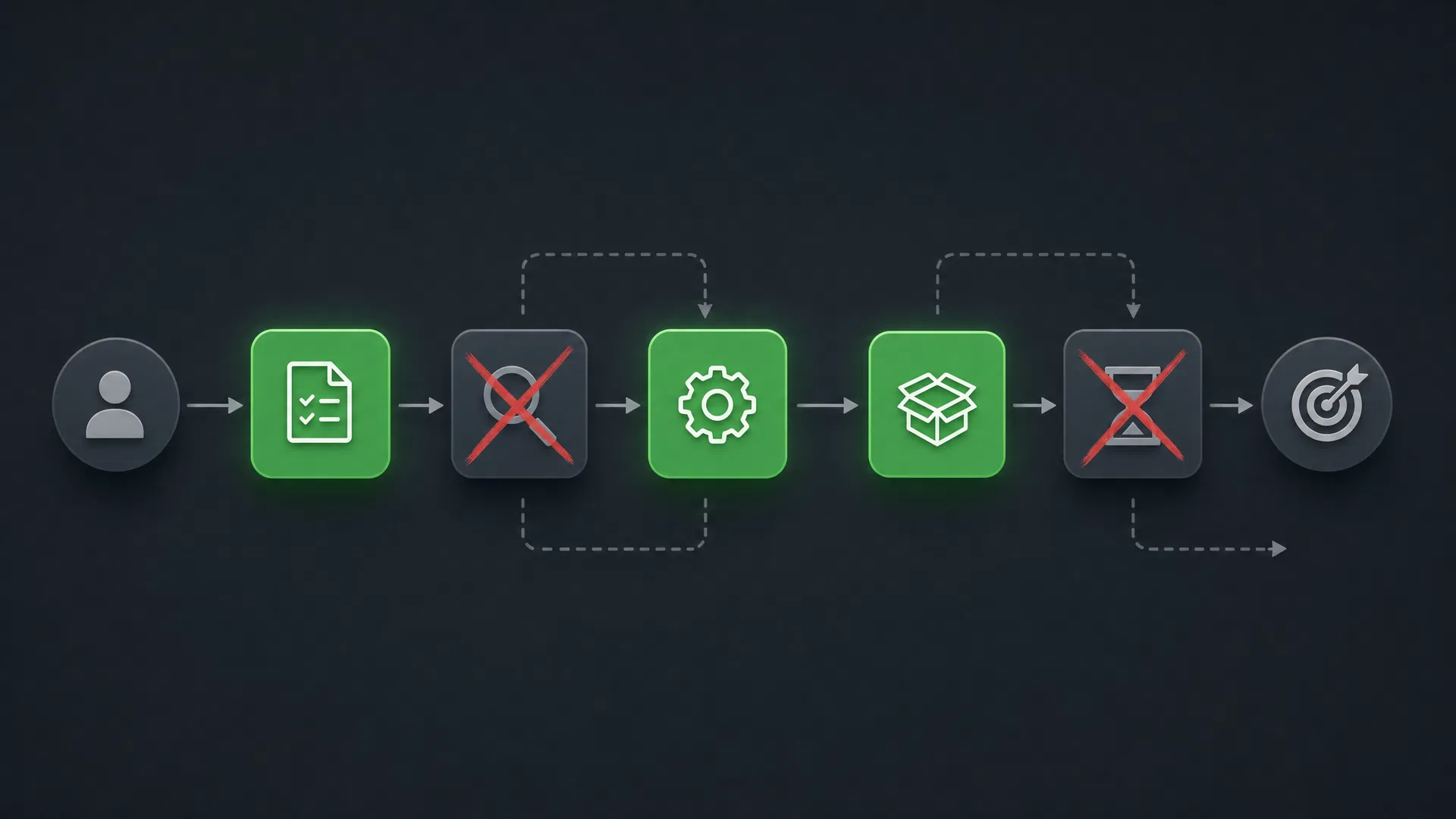
When most people hear "Lean," they think of cost-cutting. Headcount reductions. Efficiency drives. The kind of initiative that makes employees nervous and middle managers reach for their CVs.
This is a profound misunderstanding — and it is one that has caused enormous damage to organisations that adopted Lean as a cost-reduction programme rather than as a thinking framework.
Lean, properly understood, is about developing a specific kind of perception: the ability to see waste that most people walk past every day without noticing.
The Eight Wastes
Toyota's production system identified seven forms of waste — later expanded to eight in Western adaptations. They are: overproduction, waiting, unnecessary transport, over-processing, excess inventory, unnecessary motion, defects, and unused human potential.
What makes this list remarkable is not the categories themselves — it is the realisation that most of these wastes are invisible until you have a framework for seeing them.
Consider waiting. In a manufacturing context, waiting is obvious: a machine sits idle, a part waits for the next stage of assembly. In a knowledge work context, waiting is invisible. An email sits in someone's inbox for three days. A decision requires sign-off from a manager who is in back-to-back meetings. A report is complete but not acted upon because the meeting to discuss it is two weeks away. None of this looks like waste from the outside. It looks like normal business.
The Lean framework makes it visible. Once you can see waiting as waste — not as an unavoidable feature of organisational life, but as a specific, addressable problem — you start asking different questions. Why does this approval require three signatures? What would need to be true for this decision to be made in the same meeting where the information is presented? How much value is being destroyed by the time between when work is complete and when it is used?
Value Stream Mapping: Seeing the Whole System
One of the most powerful tools in Lean thinking is value stream mapping — the practice of drawing out every step in a process, from customer request to delivery, and marking each step as either value-adding or non-value-adding.
The results are almost always surprising. In most knowledge work processes, the ratio of value-adding time to total elapsed time is somewhere between 5% and 20%. The rest is waiting, rework, unnecessary handoffs, and over-processing. Most of this waste is not visible in day-to-day work — it only becomes visible when you map the entire stream.
This is what Lean thinking actually teaches: not how to cut costs, but how to see your work as a system, identify where value is being created and where it is being destroyed, and design processes that maximise the former and minimise the latter.
Lean in the Age of Automation
As automation and AI take over more routine tasks, the organisations that will thrive are not the ones that have automated the most — they are the ones that have eliminated the most waste from the processes they are automating. Automating a wasteful process produces a fast, expensive, wasteful process.
The Lean thinker's role in an automated world is to ensure that the right things are being automated, that the processes being automated are as clean as possible before automation is applied, and that the human judgment required to identify and eliminate new forms of waste is preserved and valued.
That is not a role that will be automated away. It is a role that becomes more valuable as automation becomes more prevalent — because the ability to see waste, think in systems, and design for flow is a human capability that compounds with experience.
The organisations that understand this will invest in developing Lean thinkers, not just Lean tools. And the professionals who develop this perceptual framework will find that it makes them valuable in every context where work is done and outcomes matter.
Cite this page
APA
Framework First Academy. (2026, May 7). Lean Thinking Is Not About Cutting Costs. It Is About Seeing Waste You Did Not Know Existed.. Framework First Academy. https://www.frameworkfirst.site/blog/lean-thinking-seeing-waste-you-didnt-know-existed
BibTeX
@misc{ffa-2026,
  author = {Framework First Academy},
  title = {Lean Thinking Is Not About Cutting Costs. It Is About Seeing Waste You Did Not Know Existed.},
  year = {2026},
  howpublished = {\url{https://www.frameworkfirst.site/blog/lean-thinking-seeing-waste-you-didnt-know-existed}},
  note = {Accessed: 2026-09-09}
}Learn the framework behind the article
30 courses. Four stages. Every one starts with the situation, not the syllabus.
Explore coursesKeep reading
DMAIC vs PDCA: Which One Do You Reach For? (With a Decision Table That Actually Decides)
DMAIC or PDCA? This in-depth guide breaks down the key differences, a side-by-side comparison, and a practical decision table to help you choose the right process improvement framework for your situation — with four real-world scenarios.
Python vs Excel for Data Analysis: A Framework Decision Guide
Python vs Excel for data analysis — a structured decision framework to help analysts choose the right tool based on dataset size, complexity, automation needs, and career trajectory.
Lean Six Sigma vs Six Sigma: Differences & When to Use Each
Understand the key differences between Lean Six Sigma and Six Sigma, when to use each, and how to choose the right roadmap for your process improvement goals.