First Principles Thinking: The Framework Behind SpaceX, Tesla, and Every Breakthrough Problem-Solver
April 13, 2026 · Framework First Academy
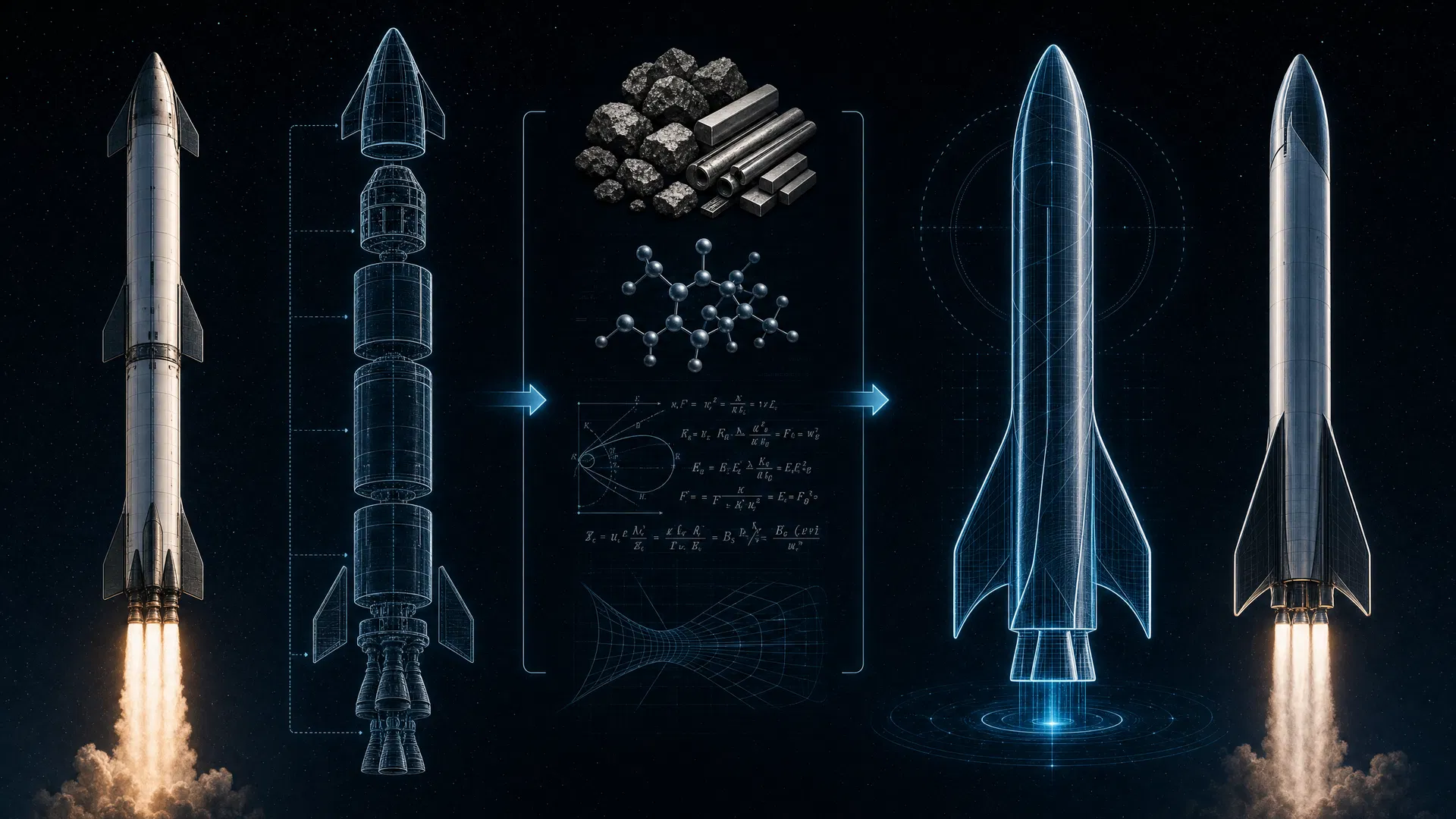
In 2002, Elon Musk wanted to buy a rocket to send a small greenhouse to Mars as a demonstration of the possibility of life on the red planet. He contacted Russian rocket manufacturers and received quotes of approximately $65 million per rocket. He could not afford it.
Most people in this situation would have either abandoned the goal or found a way to raise more money. Musk did something different. He asked a first principles question: what is a rocket actually made of, and what do those materials cost?
The answer was surprising. The raw materials in a rocket — aluminium alloys, titanium, copper, carbon fibre — cost approximately 2% of the price of a finished rocket. The other 98% was manufacturing cost, overhead, and margin. Musk concluded that if he could build a company that manufactured rockets more efficiently, he could reduce the cost by an order of magnitude.
SpaceX was founded in 2002. By the early 2020s, it had reduced the cost of launching a kilogram of payload to orbit from approximately $54,000 (Space Shuttle era) to approximately $2,700 — a reduction of roughly 95%. It had also made rockets reusable, something that established aerospace manufacturers had considered impractical.
What First Principles Thinking Actually Is
First principles thinking is the practice of breaking a problem down to its most fundamental truths — the things that are known to be true from direct evidence or logical necessity — and reasoning up from there, rather than reasoning by analogy from existing solutions.
The contrast is with reasoning by analogy, which is how most problem-solving actually works. Reasoning by analogy asks: what has been done before in similar situations? What is the conventional approach? What do other people in this field do? This is efficient — it leverages accumulated knowledge and avoids reinventing wheels. But it is also limiting — it constrains the solution space to variations on existing approaches.
First principles thinking asks: what do we actually know to be true about this problem? What are the physical, mathematical, or logical constraints? What would the solution look like if we were designing it from scratch, without reference to how it has been done before?
This approach is more cognitively demanding than reasoning by analogy. It requires the willingness to question assumptions that have become invisible through familiarity, and the ability to reason from fundamental truths to novel conclusions. It is also, when applied to the right problems, dramatically more powerful.
The Battery Problem: A Case Study
Musk applied the same first principles approach to battery technology for Tesla. The conventional wisdom in the early 2010s was that electric vehicles could not be cost-competitive with internal combustion vehicles because battery packs were too expensive — approximately $600 per kilowatt-hour.
Musk's first principles question: what are batteries actually made of, and what do those materials cost on the commodity market? The answer was approximately $80 per kilowatt-hour worth of materials. The gap between materials cost and finished battery cost was the result of manufacturing inefficiency, not fundamental physical constraints.
This analysis led Tesla to build the Gigafactory — a manufacturing facility designed to produce batteries at a scale that would drive down the cost through economies of scale and manufacturing innovation. By the early 2020s, Tesla's battery costs had fallen to approximately $100-150 per kilowatt-hour, with a stated goal of reaching $56 per kilowatt-hour.
The first principles question did not guarantee success. It identified a possibility — that battery costs could be dramatically reduced through manufacturing innovation — that conventional reasoning had obscured. Acting on that possibility required enormous capital, engineering talent, and execution capability. But without the first principles question, the possibility would not have been visible.
Why First Principles Thinking Is Rare
First principles thinking is rare not because it is technically difficult but because it is cognitively uncomfortable. It requires questioning assumptions that have become so familiar they no longer feel like assumptions. It requires the intellectual humility to say "I don't actually know why this is done this way" about things that everyone around you takes for granted. And it requires the willingness to follow the reasoning wherever it leads, even if the conclusion is inconvenient.
The philosopher René Descartes described a version of this process in his Meditations — the practice of systematically doubting everything that could be doubted, in order to identify what could not be doubted. The goal was not scepticism for its own sake but the identification of a solid foundation from which to reason.
In professional contexts, the practice looks less dramatic but follows the same logic: when you encounter a problem or a constraint, ask whether it is a genuine constraint (a physical, mathematical, or logical necessity) or an assumed constraint (something that has always been done a certain way, without anyone examining whether it needs to be). Genuine constraints limit the solution space. Assumed constraints are opportunities.
Building First Principles Thinking as a Skill
First principles thinking is a skill, not a personality trait. It can be developed through deliberate practice.
The most effective practice is the habit of asking "why" recursively — not just once, but until you reach a genuine foundation. Why is this process done this way? Because it has always been done this way. Why has it always been done this way? Because the original system required it. Does the current system still require it? Nobody has checked in fifteen years.
This recursive questioning is uncomfortable in organisational contexts — it can feel like challenging authority or questioning competence. The most effective first principles thinkers have learned to ask these questions in ways that are curious rather than critical, that invite collaboration rather than defensiveness. The goal is not to prove that the existing approach is wrong. It is to understand whether it is still the best available approach — and if not, what the first principles suggest about what the best approach would be.
Cite this page
APA
Framework First Academy. (2026, April 13). First Principles Thinking: The Framework Behind SpaceX, Tesla, and Every Breakthrough Problem-Solver. Framework First Academy. https://www.frameworkfirst.site/blog/first-principles-thinking-elon-musk-framework-explained
BibTeX
@misc{ffa-2026,
  author = {Framework First Academy},
  title = {First Principles Thinking: The Framework Behind SpaceX, Tesla, and Every Breakthrough Problem-Solver},
  year = {2026},
  howpublished = {\url{https://www.frameworkfirst.site/blog/first-principles-thinking-elon-musk-framework-explained}},
  note = {Accessed: 2026-09-09}
}Learn the framework behind the article
30 courses. Four stages. Every one starts with the situation, not the syllabus.
Explore coursesKeep reading
DMAIC vs PDCA: Which One Do You Reach For? (With a Decision Table That Actually Decides)
DMAIC or PDCA? This in-depth guide breaks down the key differences, a side-by-side comparison, and a practical decision table to help you choose the right process improvement framework for your situation — with four real-world scenarios.
Python vs Excel for Data Analysis: A Framework Decision Guide
Python vs Excel for data analysis — a structured decision framework to help analysts choose the right tool based on dataset size, complexity, automation needs, and career trajectory.
Lean Six Sigma vs Six Sigma: Differences & When to Use Each
Understand the key differences between Lean Six Sigma and Six Sigma, when to use each, and how to choose the right roadmap for your process improvement goals.