When Cloud Migrations Go Wrong: Case Studies and the Framework for Getting It Right
April 15, 2026 · Framework First Academy
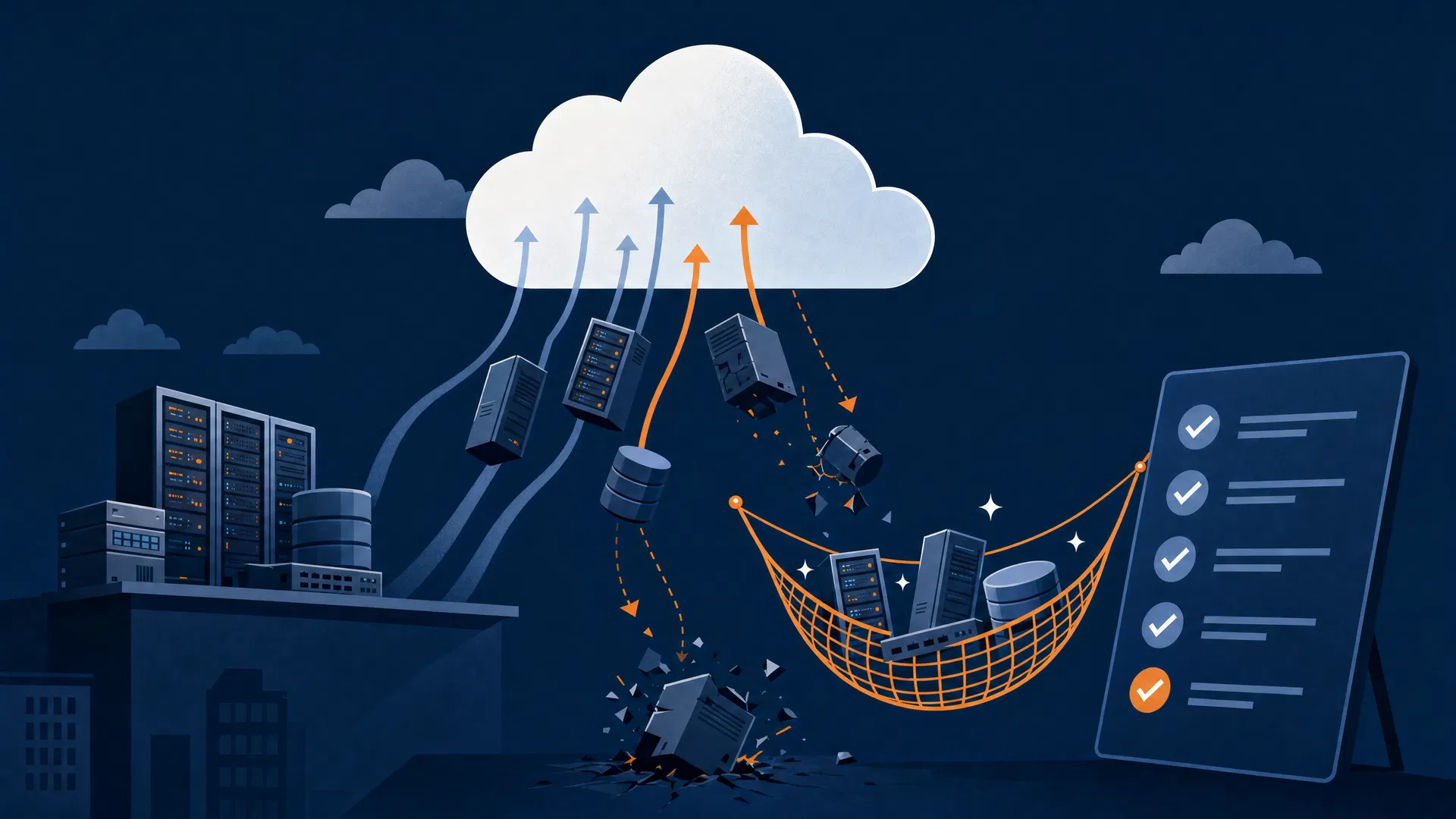
Cloud migration is one of the most common large-scale technology initiatives in modern organisations. It is also one of the most frequently mismanaged. Gartner has estimated that through the early 2020s, the majority of organisations that attempted cloud migration experienced cost overruns, schedule delays, or failed to achieve the expected benefits.
The failures are instructive — not because they reveal exotic technical problems, but because they reveal the same thinking failures that appear in every complex organisational change: insufficient problem definition, unrealistic assumptions, inadequate measurement of the current state, and a failure to account for the human and organisational factors that determine whether technology initiatives succeed.
Target Canada: The $7 Billion Lesson in Migration Complexity
Target's expansion into Canada in 2013 is one of the most studied retail failures of the modern era. While not a cloud migration per se, it illustrates the failure mode that appears most commonly in large-scale technology and operational migrations: the assumption that a system that works in one context can be transplanted to a different context without fundamental redesign.
Target's Canadian operation launched with a supply chain and inventory management system that had been adapted from its US operations. The system was not adequately tested at scale before launch. The data that populated it — product dimensions, weights, and inventory counts — was riddled with errors. The result was stores that were simultaneously overstocked in some categories and out of stock in others, with no reliable way to diagnose or fix the problem.
Target Canada closed in 2015, after less than two years of operation, at a cost of approximately $7 billion. The post-mortem identified the technology migration as a primary contributing factor — specifically, the failure to validate that the system would work correctly with Canadian data and Canadian supply chain partners before committing to a national launch.
The lesson is not that migrations are inherently risky. It is that migrations require the same structured approach as any complex problem: define the problem clearly, measure the current state accurately, identify the failure modes, design the migration to minimise those failure modes, and build in the ability to detect and respond to problems before they become catastrophic.
The Lift-and-Shift Trap
The most common cloud migration failure mode is what practitioners call "lift and shift" — moving existing applications to the cloud without redesigning them to take advantage of cloud-native capabilities. This approach is appealing because it appears to minimise risk: you are not changing the application, just where it runs.
In practice, lift-and-shift migrations frequently produce the worst of both worlds: the operational complexity of cloud infrastructure without the cost, performance, or scalability benefits that motivated the migration in the first place. An application designed to run on a single on-premises server, moved to a single cloud virtual machine, will perform approximately the same as before — but will cost more, because cloud infrastructure pricing is optimised for elastic, distributed workloads, not for fixed single-server deployments.
The organisations that achieve the best outcomes from cloud migration are those that treat it as an opportunity to redesign applications for the cloud environment, not just to relocate them. This requires a framework for evaluating which applications are good candidates for cloud-native redesign, which should be replaced with cloud-native alternatives, and which should remain on-premises — a decision that requires systems thinking, not just technical execution.
The Framework for Successful Migration
The cloud migration framework that produces the best outcomes combines several elements that are individually well-known but rarely applied together.
The first is the application portfolio assessment: a systematic evaluation of every application in the organisation's portfolio against a consistent set of criteria — business value, technical complexity, cloud-native fit, and migration risk. This assessment produces a prioritised migration roadmap that sequences migrations to maximise learning and minimise risk.
The second is the migration factory approach: treating migration as a repeatable process rather than a series of one-off projects. Organisations that migrate hundreds of applications successfully do so by developing standard patterns, tools, and processes that can be applied consistently across different applications — rather than treating each migration as a unique project.
The third is the continuous validation approach: building measurement and monitoring into the migration process from the beginning, so that problems are detected early and addressed before they compound. This requires defining success metrics before the migration begins — not just technical metrics (is the application running?) but business metrics (is it delivering the value that motivated the migration?).
These three elements are not technically complex. They are the application of structured thinking to a domain where the temptation to move fast and skip the thinking is particularly strong — because the technology is exciting, the competitive pressure is real, and the cost of slowing down to think carefully is visible while the cost of not thinking carefully is deferred.
Cite this page
APA
Framework First Academy. (2026, April 15). When Cloud Migrations Go Wrong: Case Studies and the Framework for Getting It Right. Framework First Academy. https://www.frameworkfirst.site/blog/cloud-migration-failure-case-studies-lessons
BibTeX
@misc{ffa-2026,
  author = {Framework First Academy},
  title = {When Cloud Migrations Go Wrong: Case Studies and the Framework for Getting It Right},
  year = {2026},
  howpublished = {\url{https://www.frameworkfirst.site/blog/cloud-migration-failure-case-studies-lessons}},
  note = {Accessed: 2026-09-09}
}Learn the framework behind the article
30 courses. Four stages. Every one starts with the situation, not the syllabus.
Explore coursesKeep reading
DMAIC vs PDCA: Which One Do You Reach For? (With a Decision Table That Actually Decides)
DMAIC or PDCA? This in-depth guide breaks down the key differences, a side-by-side comparison, and a practical decision table to help you choose the right process improvement framework for your situation — with four real-world scenarios.
Python vs Excel for Data Analysis: A Framework Decision Guide
Python vs Excel for data analysis — a structured decision framework to help analysts choose the right tool based on dataset size, complexity, automation needs, and career trajectory.
Lean Six Sigma vs Six Sigma: Differences & When to Use Each
Understand the key differences between Lean Six Sigma and Six Sigma, when to use each, and how to choose the right roadmap for your process improvement goals.