Cloud Computing Is Not About Servers. It Is About Thinking in Systems.
May 8, 2026 · Framework First Academy
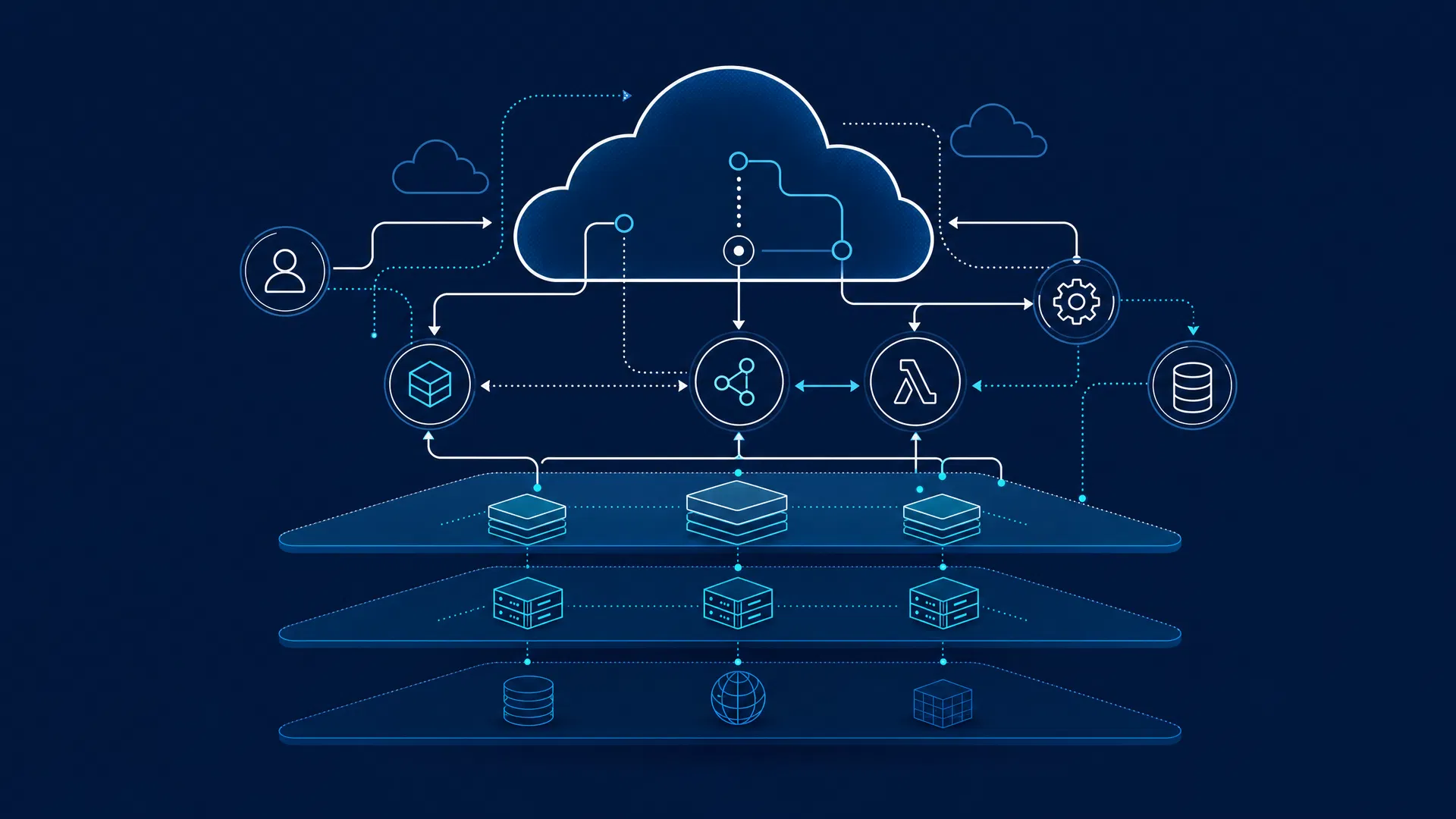
AWS has over 200 services. Azure has hundreds more. Google Cloud adds its own catalogue on top. If you approach cloud computing as a memorisation challenge — learn every service, every pricing model, every configuration option — you will spend years studying and still feel behind.
The engineers who are genuinely effective with cloud platforms do not know every service. They know how to think about systems — and that thinking framework tells them which services to reach for, when, and why.
The Memorisation Trap in Cloud
There is a version of cloud certification preparation that is pure memorisation. Flashcards for service names. Checklists of use cases. Practice exams that test whether you can recall that Amazon Kinesis is for real-time data streaming or that AWS Glue is for ETL workloads.
This knowledge is not useless — but it is not the skill that makes someone effective in a cloud role. The skill that matters is the ability to look at a system architecture and reason about it: where are the bottlenecks? Where are the single points of failure? What happens when traffic spikes by 10x? What does this cost at scale, and is that cost justified by the value delivered?
These are systems thinking questions. They require a mental model of how components interact, how failures propagate, and how trade-offs compound — not a catalogue of service names.
The Trade-Off Framework
Every cloud architecture decision is a trade-off. The framework thinker's job is to make those trade-offs explicitly and intelligently, rather than by default or habit.
The core trade-offs in cloud design cluster around five dimensions: cost, performance, reliability, security, and operational complexity. Every architectural choice shifts the balance among these dimensions. A serverless architecture reduces operational complexity and scales automatically, but introduces cold start latency and can become expensive at high volume. A managed database service reduces operational burden but limits customisation and creates vendor dependency. A multi-region deployment improves reliability but multiplies cost and complexity.
None of these trade-offs has a universally correct answer. The right answer depends on the specific system, the specific workload, and the specific business context. What the framework gives you is a structured way to reason about those trade-offs — to make them visible, discuss them explicitly, and choose deliberately rather than by default.
Infrastructure as Code: The Framework Made Tangible
One of the most important conceptual shifts in modern cloud engineering is the move to infrastructure as code. Tools like Terraform and AWS CloudFormation allow you to define your infrastructure in code — which means it can be version-controlled, reviewed, tested, and reproduced.
This shift is not primarily a technical convenience. It is a thinking discipline. When you write infrastructure as code, you are forced to be explicit about every decision. You cannot rely on clicking through a console and hoping you remember what you configured. You must state, in code, exactly what you intend — and that explicitness surfaces assumptions, catches errors, and makes the system legible to others.
The engineers who thrive in cloud environments are the ones who have internalised this discipline: make decisions explicit, make systems legible, make trade-offs visible. That is a framework for thinking about infrastructure — and it applies regardless of which cloud provider you are using or which services exist when you read this.
The Future of Cloud Expertise
Cloud platforms will continue to evolve. Services will be added, deprecated, and renamed. Pricing models will change. New paradigms — serverless, edge computing, AI-native infrastructure — will emerge and mature.
The engineers who will navigate this evolution successfully are not the ones who memorised the current state of the catalogue. They are the ones who understand the underlying principles: how distributed systems fail, how to reason about cost and performance trade-offs, how to design for change rather than for stability. Those principles are stable even as the platforms evolve around them.
Cloud computing, studied as systems thinking rather than service memorisation, is one of the most durable skill investments a technology professional can make.
Cite this page
APA
Framework First Academy. (2026, May 8). Cloud Computing Is Not About Servers. It Is About Thinking in Systems.. Framework First Academy. https://www.frameworkfirst.site/blog/cloud-computing-thinking-in-systems
BibTeX
@misc{ffa-2026,
  author = {Framework First Academy},
  title = {Cloud Computing Is Not About Servers. It Is About Thinking in Systems.},
  year = {2026},
  howpublished = {\url{https://www.frameworkfirst.site/blog/cloud-computing-thinking-in-systems}},
  note = {Accessed: 2026-09-09}
}Learn the framework behind the article
30 courses. Four stages. Every one starts with the situation, not the syllabus.
Explore coursesKeep reading
DMAIC vs PDCA: Which One Do You Reach For? (With a Decision Table That Actually Decides)
DMAIC or PDCA? This in-depth guide breaks down the key differences, a side-by-side comparison, and a practical decision table to help you choose the right process improvement framework for your situation — with four real-world scenarios.
Python vs Excel for Data Analysis: A Framework Decision Guide
Python vs Excel for data analysis — a structured decision framework to help analysts choose the right tool based on dataset size, complexity, automation needs, and career trajectory.
Lean Six Sigma vs Six Sigma: Differences & When to Use Each
Understand the key differences between Lean Six Sigma and Six Sigma, when to use each, and how to choose the right roadmap for your process improvement goals.