The Boeing 737 MAX Disaster: What Structured Thinking Could Have Prevented
May 2, 2026 · Framework First Academy
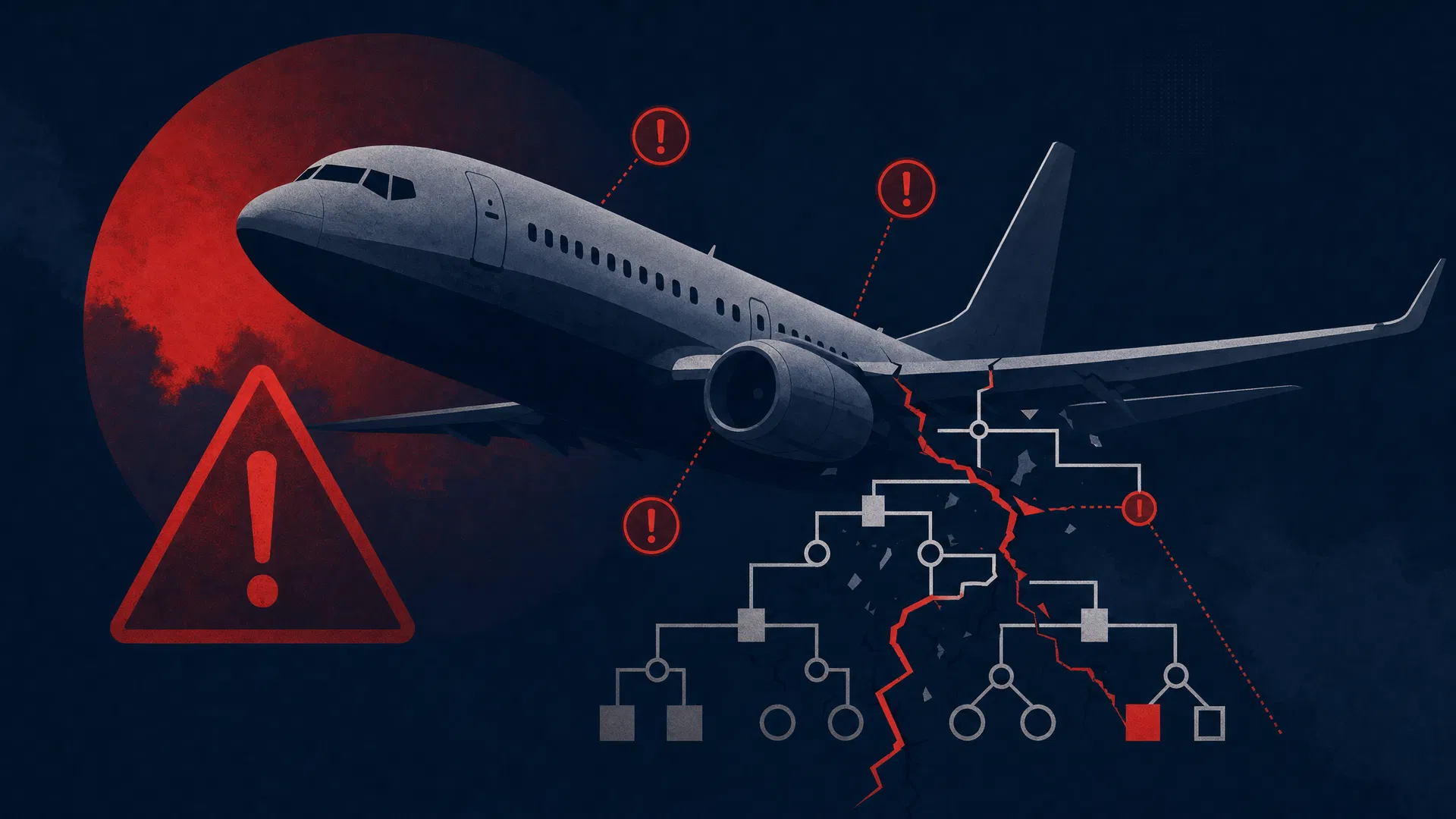
On 29 October 2018, Lion Air Flight 610 crashed into the Java Sea twelve minutes after takeoff, killing all 189 people on board. Five months later, on 10 March 2019, Ethiopian Airlines Flight 302 crashed six minutes after takeoff, killing all 157 people on board. Both aircraft were Boeing 737 MAX jets. Both crashes were caused by the same system: MCAS — the Maneuvering Characteristics Augmentation System.
The subsequent investigation revealed one of the most consequential failures of engineering judgment and organisational decision-making in aviation history. It also revealed something that extends far beyond aviation: what happens when commercial pressure overrides structured thinking at every level of an organisation.
The Problem That Was Never Properly Defined
The 737 MAX story begins with a competitive problem. In 2011, Airbus announced the A320neo — a fuel-efficient narrow-body aircraft that threatened Boeing's dominant position in the single-aisle market. Boeing's response was to re-engine the existing 737 platform rather than develop a new aircraft. This decision had a cascading consequence: the new, larger engines had to be mounted further forward and higher on the wing, which changed the aircraft's handling characteristics.
MCAS was designed to compensate for this by automatically pushing the nose down when sensors detected a high angle of attack. The system was a solution to an engineering problem created by a business decision. And from the beginning, the definition of that problem was incomplete.
The first failure of structured thinking was in the Define stage. Boeing defined the problem as: how do we make the 737 MAX fly like the 737 NG so that pilots do not need additional simulator training? This framing — driven by the commercial imperative to avoid the cost of retraining thousands of pilots — excluded a more fundamental question: is this aircraft safe to fly with the handling characteristics introduced by the new engine placement?
A proper problem definition would have included the failure modes. What happens if MCAS activates incorrectly? What happens if a single sensor fails? What happens if pilots are not aware the system exists? These questions were not asked with sufficient rigour — and the answers, when they eventually emerged, were catastrophic.
The Data That Was Not Measured
The second failure was in the Measure stage. MCAS was initially designed to activate only in specific, rare flight conditions. During development, its authority was expanded — it could now move the horizontal stabiliser to a much greater degree, and it could activate repeatedly. These changes were made without a corresponding update to the safety analysis.
The FAA's certification process relied on Boeing's own safety assessments, which contained errors. The probability of MCAS causing a catastrophic event was calculated as extremely low — but the calculation assumed that pilots would respond correctly within seconds of an unexpected activation. This assumption was never validated against data on actual pilot response times in novel, high-stress situations.
The Measure failure was compounded by a data gap: Boeing did not have — and did not seek — data on how pilots would respond to a system they did not know existed. The aircraft's flight manual did not mention MCAS. Pilots were not trained on it. The safety analysis assumed competent response to a system that pilots had never been told about.
The Root Cause That Was Misidentified
When the Lion Air crash occurred, the initial response focused on pilot error and airline maintenance practices. The deeper root cause — a system that could be triggered by a single faulty sensor and that pilots had no effective means to override in the time available — was not identified as the primary cause until after the second crash.
This is the Analyse failure. Root cause analysis requires following the chain of causation to its origin, not stopping at the first plausible explanation. The first plausible explanation — that the Lion Air crew did not follow the correct runaway stabiliser procedure — was technically accurate but analytically incomplete. It did not ask why the procedure was insufficient, why pilots were not trained on MCAS, or why the system could be triggered by a single point of failure.
A proper root cause analysis — using tools like the Five Whys or a fault tree analysis — would have traced the failure chain back to the design assumptions and the certification process. That analysis happened, but only after 346 people had died.
The Lessons for Every Organisation
The Boeing 737 MAX disaster is not a story about aviation. It is a story about what happens when structured problem-solving is systematically bypassed under competitive pressure.
The Define failure: commercial imperatives narrowed the problem definition to exclude critical safety questions. The Measure failure: safety analyses were built on unvalidated assumptions rather than empirical data. The Analyse failure: root cause investigation stopped at the first plausible explanation rather than tracing the chain to its origin. The Improve failure: the solution — MCAS — introduced a new failure mode that was not adequately controlled. The Control failure: there were no adequate mechanisms to detect and respond to MCAS activating incorrectly in service.
Every organisation faces versions of these pressures. Commercial timelines compress the Define stage. Resource constraints limit the Measure stage. Organisational politics distort the Analyse stage. The 737 MAX shows, in the starkest possible terms, what the cost of those compressions can be.
The framework does not guarantee safety. But abandoning the framework — under pressure, incrementally, with the best of intentions — is how disasters are built, one decision at a time.
Cite this page
APA
Framework First Academy. (2026, May 2). The Boeing 737 MAX Disaster: What Structured Thinking Could Have Prevented. Framework First Academy. https://www.frameworkfirst.site/blog/boeing-737-max-what-structured-thinking-could-have-prevented
BibTeX
@misc{ffa-2026,
  author = {Framework First Academy},
  title = {The Boeing 737 MAX Disaster: What Structured Thinking Could Have Prevented},
  year = {2026},
  howpublished = {\url{https://www.frameworkfirst.site/blog/boeing-737-max-what-structured-thinking-could-have-prevented}},
  note = {Accessed: 2026-09-09}
}Learn the framework behind the article
30 courses. Four stages. Every one starts with the situation, not the syllabus.
Explore coursesKeep reading
DMAIC vs PDCA: Which One Do You Reach For? (With a Decision Table That Actually Decides)
DMAIC or PDCA? This in-depth guide breaks down the key differences, a side-by-side comparison, and a practical decision table to help you choose the right process improvement framework for your situation — with four real-world scenarios.
Python vs Excel for Data Analysis: A Framework Decision Guide
Python vs Excel for data analysis — a structured decision framework to help analysts choose the right tool based on dataset size, complexity, automation needs, and career trajectory.
Lean Six Sigma vs Six Sigma: Differences & When to Use Each
Understand the key differences between Lean Six Sigma and Six Sigma, when to use each, and how to choose the right roadmap for your process improvement goals.