AWS vs Azure: Cloud Comparison, Services & Decision Guide
May 21, 2026 · Framework First Academy
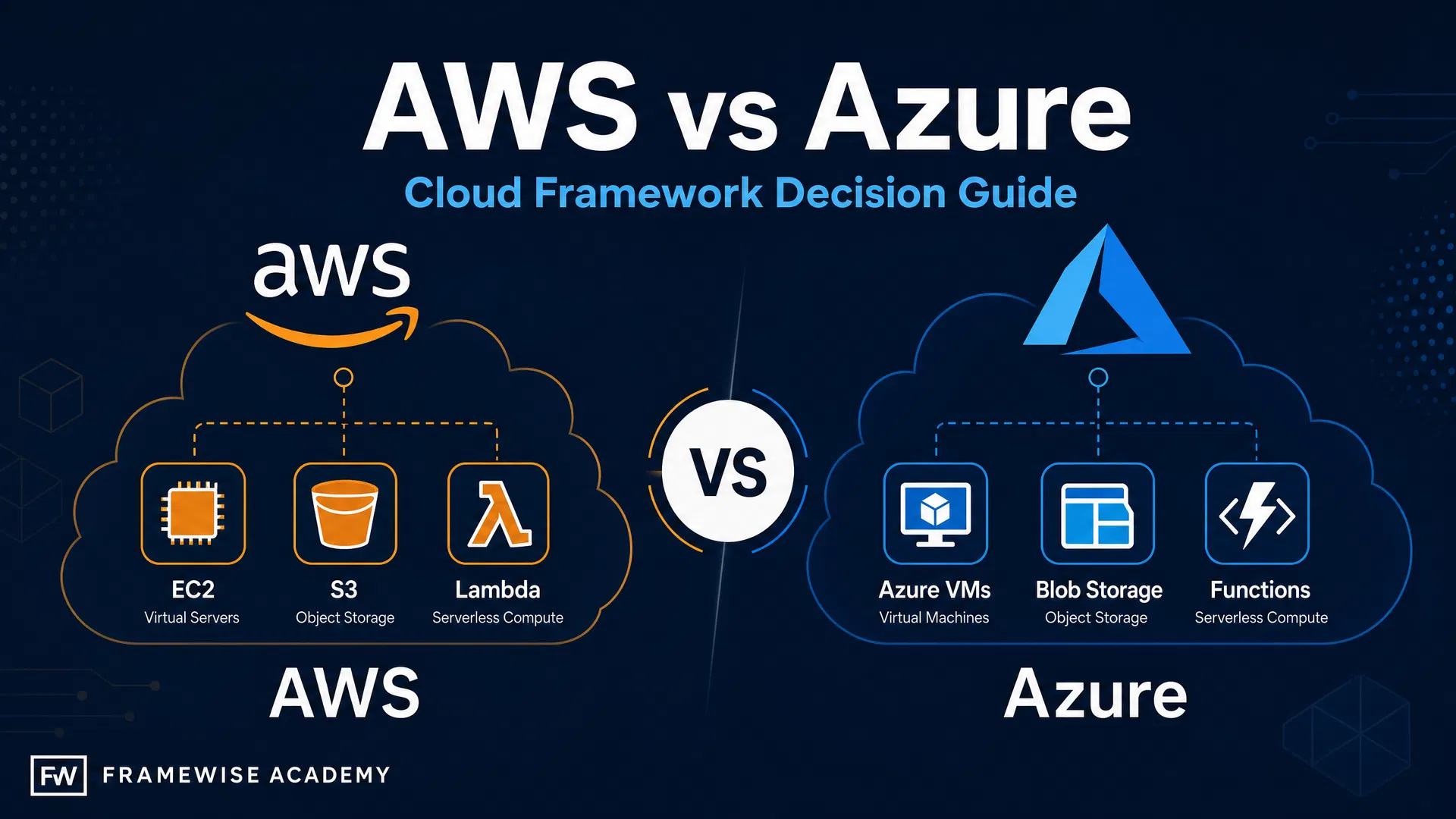
Cloud computing has revolutionized how businesses operate, offering unparalleled scalability, flexibility, and cost-efficiency. At the forefront of this transformation are two dominant players: Amazon Web Services (AWS) and Microsoft Azure. Understanding the nuances of AWS vs Azure is crucial for any organization navigating the complex landscape of cloud infrastructure. This comparison delves into their core offerings, architectural philosophies, and strategic considerations, providing a framework for informed decision-making rather than a mere feature-by-feature listing. The goal is to equip practitioners with the mental models necessary to evaluate these platforms through a strategic lens, ensuring that technology choices align with overarching business objectives and operational realities.
Introduction to Cloud Computing: AWS and Azure Overview
Cloud computing delivers on-demand compute power, storage, and IT resources over the internet with pay-as-you-go pricing, eliminating the need for on-site datacenters. AWS, launched in 2006, pioneered this space, building a vast ecosystem. Microsoft Azure, introduced in 2010, leveraged Microsoft's enterprise background, focusing on integration with existing Microsoft technologies and hybrid cloud solutions. This foundational difference often guides initial organizational preferences; those invested in Microsoft ecosystems may favor Azure, while others might choose AWS for its breadth. The decision framework here involves assessing an organization's existing technological stack and strategic partnerships, recognizing that cloud adoption is rarely a greenfield endeavor.
Core Service Categories: A Side-by-Side Comparison
A critical framework for evaluating AWS vs Azure involves categorizing their services into comparable domains. Both platforms offer foundational services across compute, storage, networking, databases, analytics, machine learning, and developer tools, though implementations and strengths vary. For compute, AWS offers Elastic Compute Cloud (EC2) with diverse instance types, providing granular control. Azure counters with Virtual Machines (VMs), offering customization and strong integration with Windows Server. Storage solutions are comprehensive: AWS provides S3 (object), EBS (block), and Glacier (archive); Azure offers Blob Storage, Disk Storage, and Archive Storage. The comparison framework extends beyond feature parity to understanding design philosophies and operational models. Organizations prioritizing raw computational power and diverse instance types might favor AWS EC2, while those seeking strong Microsoft integration might prefer Azure VMs.
| Feature Category | AWS (Amazon Web Services) | Azure (Microsoft Azure) |
|---|---|---|
| Compute | EC2 (Elastic Compute Cloud), Lambda (Serverless) | Virtual Machines, Azure Functions (Serverless) |
| Storage | S3 (Object), EBS (Block), Glacier (Archive) | Blob Storage (Object), Disk Storage (Block), Archive Storage |
| Networking | VPC (Virtual Private Cloud), Route 53 (DNS) | Virtual Network, Azure DNS |
| Databases | RDS (Relational), DynamoDB (NoSQL), Aurora | Azure SQL Database, Cosmos DB (NoSQL), PostgreSQL |
| Machine Learning | SageMaker, Rekognition | Azure Machine Learning, Cognitive Services |
| Identity & Access | IAM (Identity and Access Management) | Azure Active Directory |
Cost Models and Pricing Strategies: AWS vs Azure
Cost is a significant factor in the AWS vs Azure decision, necessitating a robust cost analysis framework. Both platforms use a pay-as-you-go model, but pricing structures, discounts, and billing granularity vary. AWS offers Reserved Instances (RIs) for 1 or 3-year commitments and Spot Instances for fault-tolerant workloads. Azure provides similar Reserved VM Instances and Spot Virtual Machines. A key differentiator is Microsoft software licensing; Azure offers cost advantages via Azure Hybrid Benefit for existing Windows Server and SQL Server licenses. This decision framework emphasizes evaluating not just raw infrastructure costs, but also synergistic savings from existing software investments and projected cloud usage, moving beyond superficial comparisons to a holistic financial framework.
Architecture Frameworks: AWS Well-Architected vs Azure CAF
Cloud solution architecture requires a structured approach, with both AWS and Azure offering comprehensive best practice frameworks. AWS provides the Well-Architected Framework, based on six pillars: Operational Excellence, Security, Reliability, Performance Efficiency, Cost Optimization, and Sustainability. This guides scalable architecture design. Azure offers the Cloud Adoption Framework (CAF), a broader guide for cloud adoption encompassing strategy, planning, readiness, and governance. Azure also has its own Well-Architected Framework with five pillars: Cost Optimization, Operational Excellence, Performance Efficiency, Reliability, and Security. The differing number of pillars (AWS: 6, Azure: 5) reflects subtle philosophical distinctions. The decision framework involves aligning an organization's cloud adoption goals with the most suitable guiding framework. AWS Well-Architected suits granular architectural best practices, while Azure CAF offers a holistic roadmap for broader cloud transformation. Both emphasize continuous improvement and adaptive design.
Certification Paths: AWS vs Azure Career Advancement
Both AWS and Azure offer structured certification paths for validating cloud expertise and career advancement. These certifications provide a framework for skill development. AWS certifications are categorized into Foundational, Associate, Professional, and Specialty levels, covering roles like Architect, Developer, and Operations, and are renewed every three years. Azure certifications are role-based (Administrator, Developer, Architect, Specialty) with fundamental, associate, and expert levels, renewed annually. The choice of certification path often depends on individual career aspirations and organizational cloud investments. A decision framework for career advancement involves assessing the prevalent cloud platform in one's target industry or current employer, and personal technological interests. For example, Microsoft-heavy organizations might favor Azure certifications, while AWS might appeal due to broader market appeal and specialized options. Both paths emphasize continuous learning and adaptation, central to framework thinking in technology.
Enterprise Adoption and Hybrid Cloud Capabilities
Enterprise adoption often involves hybrid cloud strategies and existing on-premises infrastructure. Both AWS and Azure offer robust solutions, but with differing approaches. Azure, deeply rooted in enterprise software, integrates strongly with Microsoft products like Office 365 and Active Directory, suiting organizations already using these. Azure Arc extends Azure management to hybrid and multi-cloud environments, offering a single control plane for servers, Kubernetes, and data services across on-premises, edge, and other clouds. AWS, while supporting hybrid scenarios, has focused more on cloud-native solutions. AWS Outposts extends AWS infrastructure, services, APIs, and operational models to on-premises facilities, providing a consistent hybrid experience. The decision framework here centers on an organization's existing IT landscape and hybrid cloud vision. Azure Arc suits centralized management and existing Microsoft investments, while AWS Outposts offers extending the AWS cloud experience directly to on-premises data centers. This choice reflects a framework of evaluating cloud solutions as an extension of an organization's broader IT strategy.
Choosing Your Cloud Provider: A Decision Framework
The choice between AWS and Azure is rarely a simple one, demanding a comprehensive decision framework that considers multiple dimensions beyond technical specifications. It requires a strategic alignment of business goals, existing infrastructure, team expertise, and long-term vision. Here's a framework to guide this critical decision:
Ultimately, the choice is not about which platform is inherently "better," but which platform best fits an organization's unique context and strategic framework. It's about asking "what framework helps you decide?" and "what does this choice reveal about how you think?"
Debunking Common AWS and Azure Misconceptions
Navigating the cloud landscape requires debunking common misconceptions with a critical thinking framework. For instance:
These examples underscore the importance of an analytical framework, challenging assumptions, and seeking evidence-based insights over outdated perceptions.
Conclusion
Choosing between AWS and Azure isn't about finding a single "best" option, but applying a rigorous decision framework tailored to an organization's strategic context. Both platforms offer unparalleled capabilities, with strengths catering to different needs. By systematically evaluating existing technology investments, computational demands, hybrid cloud aspirations, industry compliance, and desired control, organizations can make truly informed choices. This process exemplifies framework thinking – asking "how" to choose, and understanding the principles guiding effective decision-making in a complex technological landscape. Ready to master cloud strategy? Explore the Cloud & DevOps Track at Framework First Academy.
Continue Learning at Framework First Academy
Cite this page
APA
Framework First Academy. (2026, May 21). AWS vs Azure: Cloud Comparison, Services & Decision Guide. Framework First Academy. https://www.frameworkfirst.site/blog/aws-vs-azure-cloud-comparison
BibTeX
@misc{ffa-2026,
  author = {Framework First Academy},
  title = {AWS vs Azure: Cloud Comparison, Services & Decision Guide},
  year = {2026},
  howpublished = {\url{https://www.frameworkfirst.site/blog/aws-vs-azure-cloud-comparison}},
  note = {Accessed: 2026-09-09}
}Learn the framework behind the article
30 courses. Four stages. Every one starts with the situation, not the syllabus.
Explore coursesKeep reading
DMAIC vs PDCA: Which One Do You Reach For? (With a Decision Table That Actually Decides)
DMAIC or PDCA? This in-depth guide breaks down the key differences, a side-by-side comparison, and a practical decision table to help you choose the right process improvement framework for your situation — with four real-world scenarios.
Python vs Excel for Data Analysis: A Framework Decision Guide
Python vs Excel for data analysis — a structured decision framework to help analysts choose the right tool based on dataset size, complexity, automation needs, and career trajectory.
Lean Six Sigma vs Six Sigma: Differences & When to Use Each
Understand the key differences between Lean Six Sigma and Six Sigma, when to use each, and how to choose the right roadmap for your process improvement goals.